

The life of violet, p.1
The Life of Violet, page 1
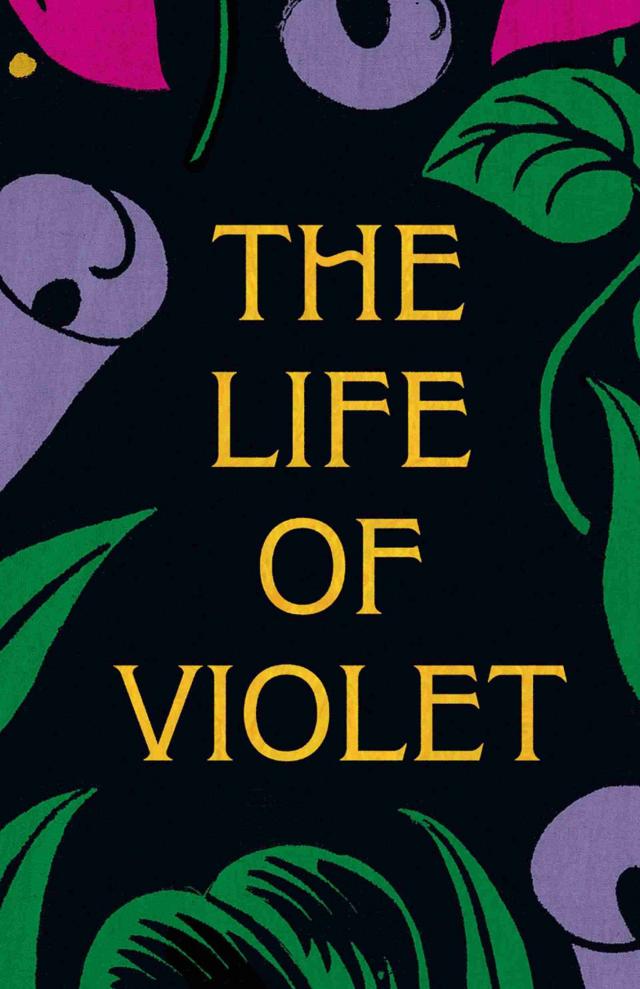


THE LIFE OF VIOLET
The Life of Violet
THREE EARLY STORIES
BY VIRGINIA WOOLF
TRANSCRIBED,
ANNOTATED,
AND INTRODUCED
BY URMILA SESHAGIRI
PRINCETON UNIVERSITY PRESS
PRINCETON & OXFORD
Copyright © 2025 by Princeton University Press
Stories from The Essays of Virginia Woolf, Volume 6: 1933 to 1941, by Virginia Woolf published by Chatto & Windus. Copyright © Virginia Woolf, 1979. Edited by Stuart N. Clarke, 2011. Reprinted by permission of The Random House Group Limited.
From The Longleat House, unpublished manuscript by Virginia Woolf, and two excerpts from a 1902 diary entry from papers of Virgina Woolf and related papers of Leonard Woolf. Copyright © the Estate of Virgina Woolf and reprinted by permission of The Society of Authors as Literary Representative of the Estate of Virginia Woolf.
Princeton University Press is committed to the protection of copyright and the intellectual property our authors entrust to us. Copyright promotes the progress and integrity of knowledge created by humans. By engaging with an authorized copy of this work, you are supporting creators and the global exchange of ideas. As this work is protected by copyright, any reproduction or distribution of it in any form for any purpose requires permission; permission requests should be sent to permissions@press.princeton.edu. Ingestion of any PUP IP for any AI purposes is strictly prohibited.
Published by Princeton University Press
41 William Street, Princeton, New Jersey 08540
99 Banbury Road, Oxford OX2 6JX
press.princeton.edu
GPSR Authorized Representative: Easy Access System Europe - Mustamäe tee 50, 10621 Tallinn, Estonia, gpsr.requests@easproject.com
All Rights Reserved
ISBN 9780691263137
ISBN (e-book) 9780691263243
Version 1.0
Library of Congress Control Number: 2025936223
British Library Cataloging-in-Publication Data is available
Editorial: Anne Savarese and Emma Wagh
Production Editorial: Terri O’Prey
Jacket Design: Katie Osborne
Production: Erin Suydam
Publicity: Alyssa Sanford and Carmen Jimenez
Copyeditor: Cathryn Slovensky
Jacket image: Raoul Dufy, Les Cornets, c. 1924, furnishing fabric made from woodblock on linen. Adapted from image © Victoria and Albert Museum, London.
CONTENTS
Illustrations ix
Preface xi
Dramatis Personae 1
THE LIFE OF VIOLET
1
Friendships Gallery 3
2
The Magic Garden 14
3
A Story to Make You Sleep 28
Afterword 41
Acknowledgments 79
Explanatory Notes 81
Textual Notes 95
Notes to the Afterword 113
Bibliography 119
Index 123
FIG. 1. Violet Dickinson, 1885, age twenty. Longleat Archives 4th Marchioness Albums 4, p. 15. Image reproduced by kind permission of the Marquess of Bath, Longleat.
FIG. 2. Virginia Stephen in 1902, age twenty. Photographed by George Charles Beresford. Platinum print. © National Portrait Gallery, London.
ILLUSTRATIONS
1. Violet Dickinson, 1885, age twenty vi
2. Virginia Stephen in 1902, age twenty vii
3. Violet’s cottage, Burnham Wood, in Welwyn, Hertfordshire 42
4. Frances Isabella Catherine Vesey, Lady Bath, 1870s 55
5. Kitty Maxse, 1922 57
6. Lady Beatrice Thynne, 1923 58
7. Eleanor (née Lambton), Viscountess Cecil of Chelwood, as Valentina Visconti (XV Century), 1897 59
8. Katherine Georgiana Louisa Thynne, Countess of Cromer, 1901–1903 66
9. Virginia Woolf (right), photographed with Violet Dickinson, 1902 77
PREFACE
READER! CAN VIRGINIA WOOLF make us burst out laughing? And does anything remain to be said about her career? A newly published work of fiction answers yes. The Life of Violet transports us into an astonishing world where a laughing giantess builds a magical country cottage in England and tames a silver-scaled sea monster in Japan. This three-part mock-biography illuminates a little-known literary episode in Woolf’s life, a slip of time between her departure from the staid South Kensington world of her birth and her immersion in the unconventional spheres of Bloomsbury.
Woolf originally drafted the fantastical, farcical, anti-fairy tales that comprise The Life of Violet in 1907, and scholars have always regarded the work as a minor confection written to entertain Woolf’s friends and family. But the discovery of a different version of The Life of Violet upends what we know about Woolf’s early efforts to revolutionize English literature. A typescript archived for eighty years in Longleat House, the magnificent Wiltshire estate of the Marquess of Bath, shows us that Woolf—only twenty-six, and still seven years away from publishing her first novel—reworked her draft of The Life of Violet in 1908 to perfect its three interrelated stories, “Friendships Gallery,” “The Magic Garden,” and “A Story to Make You Sleep.” The newfound Longleat House typescript fills in a space we never knew was blank, its refined stories marking Virginia Woolf’s first fully realized literary experiment. These stories also reveal that the future author of Mrs. Dalloway and To the Lighthouse had a flair for slapstick comedy. No restrained wit or elegant ironies distinguish The Life of Violet: these pages are exuberantly, uproariously, the-cook-fell-through-the-kitchen-floor funny.
The mock-biographical tales in The Life of Violet are loosely—very loosely!—inspired by Mary Violet Dickinson (1865–1948; fig. 1), who was thirty-seven in 1902 when she befriended twenty-year-old Virginia (fig. 2). More than six feet tall, very wealthy, and unmarried, Violet quickly became a fixture in the young writer’s world, introducing her to a wide circle of aristocratic friends and serving, in part, as a composite of the mother and the older sister Virginia had recently lost. The two friends met regularly, exchanged voluminous letters, and traveled together. Violet served as Virginia’s sounding board for matters private, public, and professional during years marked by trauma as well as creative growth. Crucially, she was an insightful reader of Virginia’s earliest writings and facilitated her first appearances in print in 1904.
In 1907, Virginia concocted three interrelated stories as an inside joke for her friend, never intending to publish them. She invented an outsize heroine named Violet who could defy governesses and gravity alike; she served up a barely disguised (and merrily skewered) supporting cast based on their mutual aristocratic friends. Amid flights of fancy—a snowfall of sugared almonds, laburnum trees that drop gold coins, bathtubs made of painted ostrich eggs—the stories brim with decidedly Woolfian subjects. History. Women’s education. The difference between fiction and biography. Above all, the stories are about laughter, especially women’s laughter, a gorgeous phenomenon that loosens repressive conventions and serves as the binding element of utopian societies. And in Virginia’s talented hands, these subjects become irresistible.
How did I have the good fortune of rousing Woolf’s typescript from its decades-long slumber in a Wiltshire manor house? Like all the best discoveries, this one happened entirely by accident. I had long ago read the three 1907 draft stories in the New York Public Library (NYPL), where they are catalogued in the world’s largest collection of Virginia Woolf’s papers as a single work called “Friendships Gallery.” (That title, incidentally, was Violet Dickinson’s; Woolf never titled the entire work, referring to it informally as “The Life.”) Charmingly typed in violet ink, the pages of this large leatherbound item bear handwritten corrections, in pencil and ink, by Virginia as well as by Violet. The stories have never been printed alongside Woolf’s better-known short fictions, such as “The Mark on the Wall” (1917) or “Kew Gardens” (1919); like most Woolf scholars, I regarded them as inconsequential early steps on Woolf’s lifelong journey of biographical experiments. But in 2018, a chance email exchange revealed that the stories archived in the NYPL were not the only versions Woolf wrote, and that she took The Life of Violet more seriously than either biographers or literary critics have realized.
In search of an unpublished memoir that Violet had written about Woolf’s childhood, I had reached out to Longleat House, just outside of Bath, where a collection of Violet Dickinson’s papers is housed. Longleat’s response to my inquiry caught me off guard: Yes, the archivists affirmed, they owned Violet’s “Memoir of the Stephen Family,” and would I also be interested in “Friendships Gallery” by Virginia Woolf?
I was bewildered. Were the archivists referring to a reproduction or facsimile of the NYPL’s “Friendships Gallery”?
“No,” came Longleat’s astonishing reply, “we hold an original Virginia Woolf typescript called ‘Friendships Gallery,’ hand-corrected by the author, and we have never heard of the NYPL’s item.”
I wrote to Carolyn Vega, curator of the NYPL’s Berg Collection, who in her turn had never heard of Longleat’s item. (Nor had archivists of Woolf’s papers at the University of Sussex, the British Library, and King’s College, Cambridge University, all of whom believed the NYPL’s “Friendships Gallery” to be the only one in existence.) Two original hand-corrected typescripts with the same title: curiouser and curiouser! What, exactly, did Longleat own? Unknown literary writings by Virginia Woolf? It was a prospect at once tantalizing and impossible.
Years passed. A sequence of obstacles—international copyright law, estate rules, the 2020 pandemic that halted travel and closed Longleat House to the public—barred my access to the mysterious new typescript. In the fall of 2022, I finally traveled to Wiltshire, and, thanks to the generosity of Emma Challinor, Longleat House archivist, retrieved the typescript from its cream-colored case. Excitement rushed through me as I saw that Woolf had indeed reworked her stories in 1908. Even a swift glance at the first paragraphs revealed a degree of polish absent in the NYPL typescript, which, it now became clear, was only a rough prelude to these aesthetically refined pieces. Turning page after page on an unforgettable October afternoon, I felt as though I were reading a new work by Virginia Woolf.
Whether you are familiar with Woolf’s novels or have yet to encounter her writing, I hope the small, well-formed stories in The Life of Violet will please you. Their riotous plots speak to readers of all ages. And like the voice of her giantess-goddess heroine, Violet—“deep with quivering shades of red and opal colour as the petals overlap each other and melt swiftly to the heart of the naked fire within”—Woolf’s budding literary gifts unfurl throughout this early biographical experiment, hinting richly at masterpieces to come.
A Note on the Edition
I transcribed the three stories that comprise The Life of Violet from a typescript archived in Longleat House, Wiltshire, which is a revised and professionally typed version of Woolf’s first draft, archived under the title “Friendships Gallery” in the NYPL. Aside from correcting indisputable spelling errors (e.g., changing “Mam’m” to “Ma’am”), I have reproduced the page layout, language, spacing, and occasionally idiosyncratic punctuation of Woolf’s revised typescript. This includes incorporating the handwritten edits Woolf made on the professionally typed pages. I made three silent corrections I considered essential for consistency or syntactical clarity: on p. 7, I have added a comma after “thing,” on p. 15, I have changed “breath” to “breathe,” and on p. 22, I have changed “begiling” to “beginning.” In keeping with accepted scholarly practice, I refer to the author as “Virginia Woolf” even though she was unmarried in 1908 and her name was still Virginia Stephen.
The explanatory notes at the end of the book provide biographical, literary, and historical context that may be helpful to contemporary readers. Readers interested in specific differences between the NYPL rough draft and the Longleat typescript should consult the textual notes.
The Life of Violet
Dramatis Personae
IN ORDER OF APPEARANCE
Lady Bath. Frances Isabella Catherine Vesey (1840–1915) married John Alexander Thynne, 4th Marquess of Bath (1831–96), and had six children, two of whom were Beatrice and Katherine (see below).
Lady Eleanor (“Nelly”) Cecil. Eleanor Lambton Cecil (1868–1959) met and befriended Virginia Stephen through Violet Dickinson. She was a prominent, active suffragist and writer. With her husband, Lord Robert Cecil (1864–1958), a barrister and politician who was awarded the Nobel Peace Prize in 1937, Lady Nelly maintained a residence in St. John’s Wood in London; the couple’s country estate was Hatfield House, a seventeenth-century Jacobean manor in Hertfordshire. The Cecils had no children. A round-the-world trip Lady Nelly took with Violet Dickinson and others in 1905 inspired “A Story to Make You Sleep.”
Lady Beatrice Thynne. Daughter of Frances Isabella and John Thynne, 4th Marquess of Bath, Beatrice Thynne (1867–1941) and her sister Katherine (see below) were members of Violet’s aristocratic social circle. They were frequent guests at 22 Hyde Park Gate, the Stephen family’s London home. Woolf writes of attending balls and parties with Beatrice, who never married.
Kitty Maxse. “The brilliant the sparkling” Katherine Lushington Maxse (1867–1922), as Woolf described her, was, along with her two sisters, very close to the Stephen family during Virginia’s adolescence and young adulthood. Kitty married Leopold Maxse (1864–1932), the prominent conservative editor of the National Review, in 1890. The Maxses had no children. Kitty was a well-known society hostess before her sudden death in 1922. She is regarded as the model for Woolf’s Mrs. Dalloway in the 1925 novel of the same name.
Lady Cromer. Katherine Georgiana Louisa Thynne (1865–1933), Countess of Cromer, was the second wife of the statesman and antisuffragist Evelyn Baring, 1st Earl of Cromer (1841–1916) and “Maker of Modern Egypt.” They had one son, Evelyn (1903–73), who would become governor of Kenya.
Mrs. Crum. Ella Sieveking Crum (1863–1948), a painter and member of the Ipswich Fine Art Club, was married to the Coptic scholar Walter Ewing Crum (1864–1944). The couple had no children. Woolf often mocked the Crums, who were primarily Violet’s friends, for what she judged as their gauche or thoughtless behavior.
1
Friendships Gallery
FORTY YEARS ago (our sincerity does her credit) a child was born in a Somersetshire Manor house. Whether she was born laughing or crying, or both at once, or whether she merely accepted the situation and made the best of it, a sincere historian, anxious to use only those words that cannot be avoided, has no means of telling.
But there never was such a child for growing.
“Nurse, bring the weighing machine,” said the doctor.
“It’s the foot rule you want Sir,” said Nurse, “if I may make so bold.”
But here the child burst out crying, so lustily that all who had charge of her agreed that she was the cleverest child, the noisiest child, and the child with the finest lungs in the Parish, and that the sooner she was christened the better.
But what can you call a child, a woman child?
Now the history of Christian names is so interesting that if I had the freedom of my mother tongue, as I have it not, for a reason to be told in the appendix, I would here expound it; I will only say that forty years ago a Christian name was a Christian name, and that if you wished your daughter to answer with credit in this world and the next you branded her with the virtues of the faith from the very beginning. So when the long baby was held over the font god-mothers and god-fathers muttered, as people do on those occasions, “Mary” and when the clergyman said “Is that all?” and smiled, as though he could tolerate a little vanity now, they added “Violet” in the bolder tones of people who are come out of church though the hush is still on them. But as the child grew and became capable of inspecting her two names, of comparing them with others, she decided that though it was good to wear Mary next your skin, it was better to show Violet outside. “Miss Violet Dickinson” then, and if it hurts you to think that Lycidas was once a matter of conjecture it hurts me still more to consider how nearly Violet was Mary, how easily Dickinson might have been Jones. Here again I would digress. But this is one of Violet’s earliest sayings.
Her mother. “I wish you would learn to write Violet.”
Violet. “I won’t write; I’d rather talk.”
Miss Violet Dickinson grew to be as tall as the tallest hollyhock in the garden before she was eight, but after all our concern is with her spiritual progress. True, her size alarmed her family; her position in the ball room, they thought, might be seriously prejudiced, and before she drove to her first dance, in the Bath Corn Exchange, she had to submit to a solemn exhortation from her Aunt, who was also her godmother.
“Mary Dickinson,” began the Aunt, using as Aunts do, the least palatable expression, “remember that you are neither beautiful nor wealthy, nor, for anything I can see, in any way attractive; God in his infinite goodness has caused you to grow at least six inches higher than you should grow, and if you are not to be a Maypole of Derision you must see to it that you shine forth as a Beacon of Godliness.”
The Dickinsons we must add, are a Quaker family, related to William Penn, for they were transported to America in the 18th Century for stealing silver spoons.






