Pilgrimage v1 0, p.1
Pilgrimage v1.0, page 1


“Of course there are lands!”
Brann exclaimed. “What oi the Fanny Fields, what of the mountains?”
“Yon interpret it incorrectly, young man,” die Hegman answered. “Yon begin from the most erroneous premise, that there is an inside and an outside to the city, a city and a planet, I suppose, upon which it rests. All that, of coarse, is nonsense.
“The eye will fill what is empty, young Brann. If there were lands, there would certainly be folk to fill them, and if such folks then we would have seen them. True?”
“True,” Brann answered, reluctantly.
“Have we seen such folk?” asked the Hegpran.
“No,” said Brann.
“There is the city, there are die mountains and the delds. They are one, and all beyond their unity is only the vision of things and this vision is nothing more than that, for the eye abhors emptiness and will fid it always. When you learn the true answer, you must stop questioning and begin to learn,” said the Hegman. “And that is that.”
PILGRIMAGE
Drew Mendelson
DAW Books Inc.
Donald A. Wollheim,Publisher
1633 Broadway, New York, N.Y. 10019
Copyright ©, 1981, by Drew Mendelson
All Rights Reserved.
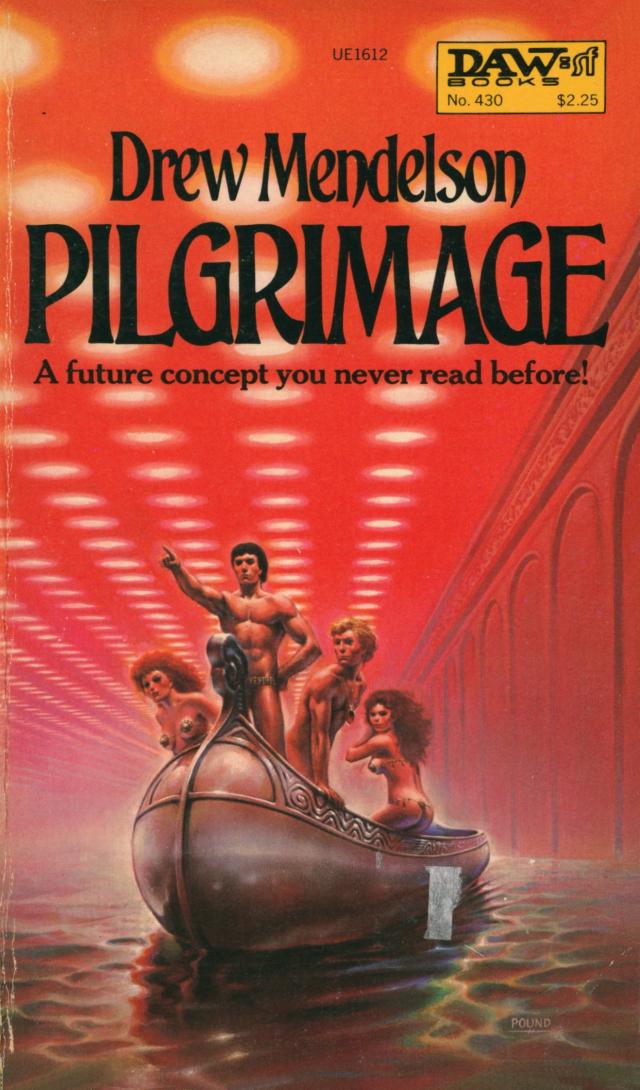
Cover art by John Pound.
FIRST PRINTING, APRIL 1981
1 2 3 4 5 6 7 8 9
DAW TRADEMARK REGISTERED
U.S. PAT. OFF. MARCA REGISTRADA,
HECHO BN WINNIPEG, CANADA
PRINTED IN U.S.A,
Contents :-
BOOK ONE
Chapter One Tailend
Chapter Two The Dwarf
Chapter Three The Shaking
Chapter Four Driver
Chapter Five The Stairs
BOOK TWO Chapter One Huten
Chapter Two Fever Dream
Chapter Three The Prison
BOOK THREE Chapter One Frontend
Chapter Two The Folk
Epilog
BOOK ONE
Chapter One
Tailend
On the 37th tier of Tailend, above the Foundations and the Fanny Fields, above the trolley tracks where the engines ran below like minute centipedes, above the valley, at times .above the clouds, Brann Adelbran lived. He was a clean limbed youth of seventeen, brown-haired, hazel-eyed. He was taller than many though shorter than some, and while not stocky he had a large and heavy build that a few years hence, when fully fleshed into that of a man, would make him a powerful and formidable figure. So his brother Grandel was and so his brother Mikla was becoming in so swift a fashion that it frightened Brann and sent him, envious and jealous, to the verge where the empty beams of a dismantled gallery extended beyond his own gallery’s edge. There he could watch the Structors work thirty tiers below, like savage rodents gnawing at the base of Tailend. There he could look out across the valley at the Foundations which had supported Tailend before, at their regular stone and concrete impressions, the imprints of the city’s bones. They became lost in the haze, and try though he might, he could never find where they began to climb the mountain rampart beyond.
Brann was the third oldest of eight siblings, who along with Grandel and Mikla included in descending age sisters Livna and Sal (twins), Gwenia, brother Thod and baby sister Nam. Grandel no longer lived at home. He occupied a house next to the family plat, but nearer as by custom to the gallery verge where the Structors would begin dismantling tier 37 when they came. Grandel had a wife, Mara, and a baby, and he had no pretense of any noble purpose in his life, as did Mikla, or as Brann thought he himself had. Grandel and Mara ran a clothing shop which occupied a space among other shops on a spur of the trans-tier highroad. Their sole aspiration was that when the Structors came again in seven years they should be prosperous and respected enough to be leaders on the Pilgrimage to Frontend.
Mikla had a purpose. When the Structors came again he would join them. By then he would be as brawny as Grandel, seven years older, nearly twenty-six, and a fit candidate for their ranks. Brann could not really understand the single-mindedness which drove his older brother to plan for an event that would occur seven years later, if at all.
“Mikla,” he would say, “how do you know that they will take you?”
“I am as strong as any,” Mikla would say. “They want brawn. And “I’m not stupid either. They want no one stupid. Do you know that one misstep could bring down a whole tier? Do you know that they must calculate the stresses to the finest margin? Can you imagine the mass and heft of the blocks that support this tier? Their structural integrity? They’ve accepted me into the guild school. That’s half of it. They don’t accept many. I’ll learn what it takes. I’ll finish the school; they’ll let me join join them.”
Often at these times Brann would not listen to Mikla. He was, after all, seventeen; new sensations and emotions were within him. There were feelings that he had never known, so subtle and yet at times so feverish inside him that he would sit on the beam next to Mikla and while Mikla talked (ceaselessly, not noticing that Brann was not listening), he would throw soft bits off the verge, paper and cloth shreds and bits of leaf and stick. He would watch them flutter weightlessly down through currents that always swirled about Tailend. He knew better than to throw anything hard, anything of stone or metal which might gather killing momentum as it plunged past the tiers. What had been law, had grown past law to an ingrained—perhaps hereditary—taboo. Still, he had no comprehension of the velocity a stone would obtain falling down a mile, down thirty-seven tiers to the Foundations or the Farmy Fields.
The juices in Brann were love; Brann was sick in love with a girl who lived blocks away at the innermost line of the gallery. Every day after school he would run to her house, waiting to see if she was home yet. She was younger than he by nearly a year, a slender, red-haired girl of sateen. He didn’t know that he was in love with her. He only knew that when he tried to study or to work or play, he would catch a whiff that might have been the perfume of her, or he would catch a flash of red that might have been her hair. She lived near the market square and he would traverse this in his travels to see her. Before, even as much as six months earlier, Brann would have thought nothing at all of her. He would have been enthralled only by the market, a place which had fascinated him since childhood.
The market was laid out on a plat a square acre in area. Its rear side abutted the wall dividing Brann’s gallery from the one farther in. Between the arches which pierced this wall were the elevators. They were massive things, ten yards wide and deep, half that distance high, with doors that opened vertically like lips covering a great mouth. There were two elevator shafts side by side. In one the cars went only up, in the other only down. It had seemed to Brann in times past that this could not be, that eventually they could rise no farther, that they must come to a stop at the city’s roof 113 tiers above the ground.
He had an image of artisans at the roof whose only labor it was to take the cars as they came and tear them down to make room for the following cars (as the Structors endlessly tore down the tail end of the city). He could not imagine that the two shafts were part of the same system, that the cars rose up two more miles to the highest tier, were moved over to the down shaft and dropped. There was one main reason for the down shaft; the Pilgrimage, still seven years off; and not even folk from tier 113 had yet begun their Pilgrimage.
There were other shafts in banks to either side of the large elevators. His mother told him that at one time these shafts also held elevators. These moved no produce, freight or trade goods; they moved people from tier to tier. Brann could not imagine traveling up the tiers other than by foot. Having been up to tier 40 one time at the death of his great aunt Hela, and down to tier 35 on his own, in direct contravention of his parents’ order never to leave his home gallery without permission, he could not really fathom the distances one might travel by elevator up or down.
The smaller shafts were empty, their doors covered over, bricked in and sealed so long ago that it was scarcely understood by anyone that they were actually elevator shafts. One shaft had, until recent times, been accessible. Its door was inside an alley formed by the wall of an ancient houseplat built near the inner face of the gallery. Half a year earlier, the boys with whom Brann played had discovered this sealed elevator door, had found that the mortar of its bricks was loose and crumbling. They had gradually opened a hole into the brick and found that the shaft doors behind it were not closed.
One boy, Halsam, a neighbor of Brann’s, more daring than the others, had run home to get a flashlight and bring it back. Then he had wormed his way through the hole and out onto a narrow ledge which occupied three sides of the shaft
“What do you see, Hals?” Brann asked.
“Nothing,” said Hals. “It just goes down. Even with the light I can’t see far.”
Brann edged out onto the ledge next to Hals, gripping the edge of one of the partly open doors for support. A smell permeated the shaft, powerful and unidentifiable, wet and rancid and old. A cold-air current fell past them.
“Papa says it is always cold on the upper tiers, even in summer. He says that there’s snow on the upper galleries all the time,” Brann told Hals.
Another boy squeezed through and a fourth, until Brann was pressed to the far right wall of the shaft, to where the ledge was slimy and wet and the handhold slippery. Something fell, perhaps a brick. It plunged down the shaft creating a reverberation that faded into the constant noise inside, a steady deep hum. Below, as if from occasional windows, spots of light picked out gray spaces which gradually blended into a gray blur as the shaft descended. Brann had no concept of the distance down, and here in the dark for the first time he felt a vertigo that never came to him when be perched on the empty beams at the open end of his gallery.
“There is a ladder here,” Hals said. “I’m going down.”
“No, you can’t,” one of the other boys told him uncertainly. “How do you know how far the ladder goes?”
Hals shined the light upon it and followed the corroded steps down to where it touched the ledge of the next level, 150 feet below. Then he moved around on the ledge, sliding over slick spots that made Brann hold his breath and say, “Come back, Hals,” and then Hals was on the ladder.
He said, “I think I can see an opening. The ladder looks good down that far. I’m going.”
This was an enticement that overshadowed danger. On the stairs between levels, adults always asked what reason a boy had for leaving his own level. This was a secret pathway down. The boys delighted in its possibility and forsook fear. Hals stepped down. For a moment he grinned, showing the others how easy it was. The step gave way beneath him. It parted from the ladder with a shrieking noise that was hardly separable from Hals’s shriek. He lost his grip on the flashlight which tumbled, spinning, down, and he clung to the ruined ladder, finding purchase for only one foot on the ledge. Hals was transformed instantly from explorer to child, a frightened, crying child who held tight to the metal and begged the other boys to go for aid.
Adults came and after Hals had been brought out safely, his mother, when he was at last pulled free, alternately cried in relief and screamed in anger, beating Hals and holding him in turn. The shaft was sealed again, securely this time, and the boys were forbidden even to go near it
In the market itself were open stalls of produce: fruits and vegetables and grains that would not grow or for which there was too little room to grow on the open dirt plots of the tiers. (The lights in the ceiling, which was the floor of the tier above, duplicated, Brann knew, the light of the sun in a way that allowed plants to grow within the galleries.) But there was no such profusion of produce cultivated within the city itself. All this was grown in the Farmy Fields which stretched out as far as Brann could see to either side of the Foundations. Farther off toward the mountains the fields merged with the Foundations themselves. Brann had asked his father if there were folk who lived there, too, in the Farmy Fields rather than in the city itself.
But his father, as always when he did not know, said, “It is not to be asked.” (So many things were not to be asked.) And Brann asked his cousin, Vill, who was an elevator runner and traveled up and down the great shafts in the cars which carried the produce. Surely his cousin would know. But Vill had said he did not know either. Brann could scarcely believe this of Vill, who in his guild uniform of deep green with gold piping (of the Runners’ Guild, older even than the Structors’) surely was more widely traveled than anyone he knew. But Vill had said that even he had gone down and up only twenty levels, two days’ run by elevator. He had never been all the way down to the bottom, to the ground where the Farmy Fields came up to Tailend and the trolley came to carry folk off on the Pilgrimage.
“Maybe on the Pilgrimage you will find out,” Vill told him. “On the Pilgrimage you will see things that I have never seen: the flank of the city where it is said you can see from Frontend to Tailend of the city. On the Pilgrimage you will learn more than you ever will in school.”
Cousin Vill said that he personally didn’t think people lived outside the city or worked in the Farmy Fields. He told stories of machines, “like the trucks on the highroad,” which traveled to and from the fields, with brains like men and women, with arms and hands like them; they never tired or slept. But Brann thought them myths to frighten children—and he was no longer a child—and believed little of what cousin Vill told him. After all, Vill did little more than travel in the cab of the elevator, up two days to the 57th level and down two days to the 17th level, staying in guild houses between. He did bring back marvels at times, intricate mechanical toys from the 44th level that were like humans in miniature, all shiny metal that walked and danced and sat and climbed and needed only the light to revive them when they had tired from their exertion. He brought back cakes and pastries from level 21 that were decorated as if they were galleries in scale with the crowded houseplats and gardenplats seen from a height seemingly impossible. The buildings of the gallery diminished to each side as they must do toward the flanks of the city, 40 miles shrunk to a cake a yard long and a couple of inches wide. Brann had one cake that he had never eaten, stale by now but still a marvel, kept on the shelf above his bed where he could imagine that the cake was actually the gallery in which he lived. He tried to imagine an in* terminable succession of galleries like this cake, laid side by side, stretching from Tailend to Frontend of the city, each one a tier, and 113 of these layers one on top of the other from ground to roof of the city.
Like Mikla, Brann too had a purpose: he would carry the post. Of all the eighty-odd guilds of Tailend, there was only one Brann wanted to join. It was the Post Guild, and Brann had dreamed of it ever since he knew that there were folk who could move freely from one end of the city to the other, from gallery to gallery through the walls and arches, from level to level; not just two days up and two days down, but days and days beyond into the interior of the city, past galleries that he knew, past galleries that anyone knew (it seemed), to where the city changed, to where there were folk who spoke in ways different from how he spoke and lived in homes that were in no way like the home in which he lived, to places where none had seen the Farmy Fields, or the mountains or the sky in generations. (Perhaps the generations were beyond counting; certainly their number was beyond his understanding.) But the Post Guild moved freely from one end to the other.
Brann had tried without success to discover how one went about joining the Post Guild. The guild house, near its own post elevator (on which none but guild members could travel) between the shafts of the great elevators, was closed to all but men and women of the guild. None had contact with them, save in the stations where the guildspersons dealt with the folk through windows that opened into mysterious paper-cluttered rooms.
“How do I join?” Brann had asked when one day he had gone to retrieve a letter which could not be delivered in person.
“How old are you?” the guildswoman had inquired in turn.
“Seventeen.”
“Ah, then you are too young.”
“How old must I be?”
“How old do I look?”
“Twenty?”
“Yes,” she had laughed just a bit “And I have been in the guild for five years now.”
He was perplexed, and asked how this contradictory answer could be.
“Some are never old enough; some are always old enough.” Her voice was strange, a musical accent of tones and odd cadences.
“You are not of this gallery,” he said.
“No, I come from farther frontward.”
“Is that where I may join the guild?”
“You certainly cannot join it here.”
“How do I join?”
“I cannot tell you; you must keep asking.”
That had been no answer at all.
He was in love. The girl was Liza, with red hair and with freckles across her nose. He didn’t know that he was in love, not really except that things happened inside him when he saw her. He stammered when he saw her though otherwise he was always so swift with his questions and with his words. He blushed when he saw her though usually he was unafraid and unashamed of anything. He was terrified of being with her, but he tried always to be with her, when school was done and when his work in the gardenplat was done and neither Mama nor Papa could find further chores for him to do. She was not sure she wanted it yet; she was no more really woman yet than he was really a man. They were both no longer children and both not quite adults, and he loved her. It did not matter much about this love, for nothing could ever come of it They could not marry, lovers or no. There were strict rules about it (Were there an Anthropologists’ Guild, it would have been said that the tiers were a set of interlinked exogamous phratries. This had been so since anyone could remember. Had there been anthropologists among the folk, they would have said that this marriage outside the home tier was purposely designed to strengthen the close trade relationships among the galleries. Since there was no such guild, no one said this. They thought not in those terms, but it mattered not, the damage was done.) Liza and Brann, of the same tier, of the same gallery, could not marry—no more than could brother and sister. Of course, nothing prevented them from being together, from spending all their time together, even from engaging in a bit of harmless sex play, which when it became serious enough to be noticed by the adults would only serve to indicate that the children were children no longer and should perhaps begin to look for mates from among the folk of tiers above and below.