

Murasaki, p.1
Murasaki, page 1
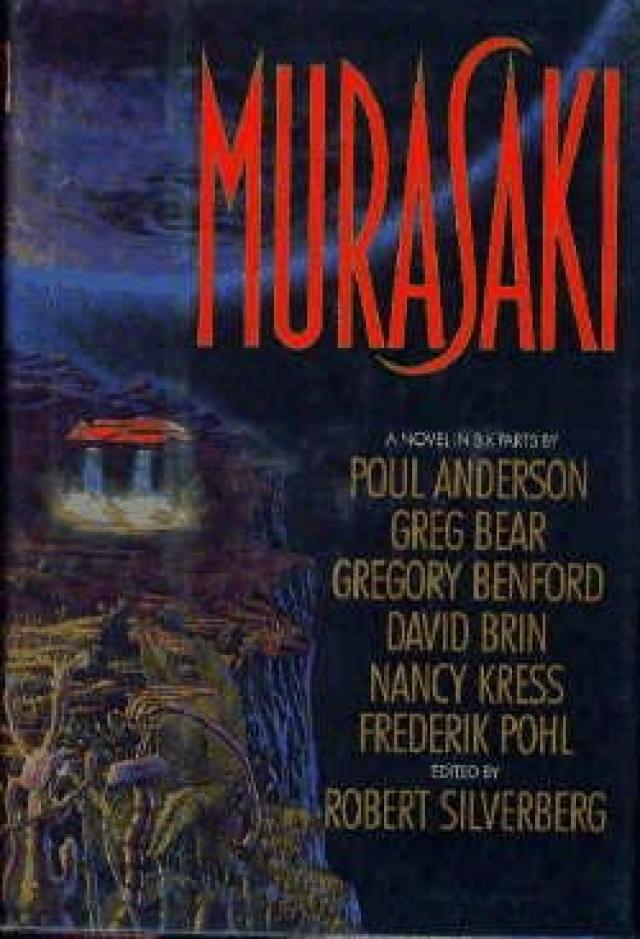


Murasaki
A Novel in Six Parts by Poul Anderson, Greg Bear, Gregory Benford, David Brin, Nancy Kress, Frederik Pohl
Anthology, Edited by Robert Silverberg
1992
ISBN 0-553-56187-I
“In addition to providing the narrative framework for Murasaki, Mr. Anderson and Mr. Pohl have each written one of the novel’s six chapters; the other four contributors are David Brin, Gregory Benford, Greg Bear and Nancy Kress. What they have accomplished is a worthy feat of metafiction. For all their individual quirks of style, and outlook, their contributions fit together like pieces of a puzzle, just as the ecological and evolu-tionary facts about Genji and Chujo fit together into a grand design that does not become apparent until the end of the book....
“Of such details are worlds, and stories, made.”
–The New York Times Book Review
A scaled-down verson of Medea, Harlan Ellison's shared-world anthology based on a scientifically created world, this effort is, unfortunately, smaller in every sense. The talent pool (six writers, as opposed to Medea 's 11) is limited to winners of the Science Fiction Writers of America's Nebula Award. Unlike the contents of Medea , these stories are linked and form a novel-like progression. The entries proceed chronologically, starting with the first humans to land on Genji and To no Chujo, the twin planets surrounding the sun Murasaki, and closing with the end of a centuries-long cycle involving both Genjians and Chujoans. Assorted conflicts among and scientific discoveries by the visiting humans constitute the middle sections. Although the contributors—Poul Anderson, Greg Bear, Gregory Benford, David Brin, Nancy Kress and Frederik Pohl—are all accomplished stylists, one finds little distinctions among their six chapters. If the planet Medea was a playground for writers' imaginations, the star Murasaki seems a pigeonhole that writers must subordinate their imagination and style to fit.
— Publisher's Weekly
The arrival of human colonists in the Murasaki system to explore and settle the twin worlds of Genji and Chujo forms the background for this shared-world anthology. The six stories by Nebula award-winning authors Poul Anderson, Greg Bear, Gregory Benford, David Brin, Nancy Kress, and Frederik Pohl focus on the effects of human intervention on an alien ecosystem. A pair of essays by Anderson and Pohl provide background information and offer a rare glimpse of the planning stages of this experiment in sf world building. All in all, this satisfying blend of hard sf and expert storytelling should be considered by libraries with large sf collections.
— Library Journal
Contents
Introduction
The Treasures Of Chujo
World Vast, World Various
1. The Cusp Moment
2. Arrested Athens
3. So-So Biology
4. The Library
5. I-Witnessing
6. Paradigm Lost
Genji
A Plague Of Conscience
Language
Birthing Pool
Appendix A: Design For Two Worlds
The Sun
Planets
Genji
Chujo
Life
The Land Genjians
More About Genji
Chujo
Life On Earth
The Interstellar Ships
A Puzzle For Planetographers
How Humans Live On Genji/Chujo
The Chujoans
About The Authors
Introduction
This book is an anthology of new stories set within a single conceptual framework, pro-duced jointly by a group of science-fiction writers—a kind of collective enterprise that is known in the world of science-fiction publishing as a “shared-world” anthology. Many such shared-world volumes have been released in recent years. What is special about this one, is that all the writers involved in creating it were winners of science fic-tion’s highest award of professional excellence, the Nebula. Never before has a group of Nebula winners been brought together to apply their very diverse talents to exploring the same set of ideas and characters.
Science-fiction writers are notoriously individualistic in their private lives, political positions, and professional demeanor. It’s a field richly populated by lone wolves, lib-ertarians, nonconformists of every stripe. They tend to think their own thoughts and go their own way. Most of them resist editorial tinkering with their work and are usually unhappy in the fundamentally collaborative atmosphere of a place like Hollywood, where writers are (rightly) consid-ered to be nothing more than members of a large team, and not very important members of the team at that.
How very strange, then, that this collection of cantan-kerous individualists would have embraced with such en-thusiasm the collectivist concept of the shared-world anthology. To work with other people’s ideas—to volunteer for positions in what are essentially round-robin novels written by many hands—to take pains to make certain that their contributions to these books don’t violate the previ-ously determined conceptual boundaries of the project—it seems the tithesis of individualism in every way. And yet throughout the history of the science-fiction field such shared-world projects have attracted some of the most tal-ented writers of each period.
One of the most famous of these joint enterprises was hatched in the earliest days of science fiction as a special-ized form in the United States. This was the seventeen-part serial novel Cosmos, which was published in 1933 and 1934.
The contributors to Cosmos were the top-ranking pro-fessional science-fiction writers of the era.
The roster in-cluded some authors whose names today are nothing more than trivia-contest items—Abner J. Gelula, Bob Olsen, Francis Flagg, J. Harvey Haggard. But also we find, among those who turned out the monthly Cosmos chapters, such titans of science fiction and fantasy as John W.
Campbell, Jr., E. E. Smith, Ph.D., A. Merritt, and Edmond Hamilton, who wrote the spectacular final chapter, “Armageddon in Space.”
Cosmos was a romp, a spoof, an exercise in sheer science-fictional playfulness, tremendous fun for writers and readers alike. But the next shared-world project that comes to mind was a very serious endeavor indeed.
This was a volume called The Petrified Planet, pub-lished in 1952, for which the scientist John D.
Clark worked out the chemical and biological specifications of a planet where the basic element of life was silicone, rather than carbon as it is on Earth, and three outstanding writers of the time were invited to contribute novellas based on Dr. Clark’s technical data. The results were outstanding: a trio of stories that bore no relationship to one another in plot, character, or theme, and yet grew organically out of the same set of scientific postulates.
Other shared-world books followed, over the years. The most remarkable such project of this sort, I think, was Harlan Ellison’s epochal Medea, which was published in 1985 after a ten-year gestation period. It was Ellison’s bril-liant idea to create a science-fictional planet by a three-stage process: first, some of the field’s top idea-men would produce essays setting forth the astrophysics, geology, bi-ology, oceanography, and even the politics and theology of the hypothetical world. Then four other writers would be handed the booklets containing all this information and would go on stage (during a series of major science-fiction seminars held before a general-public audience at the Uni-versity of California, Los Angeles), in an attempt to improvise plot structures for stories set on this world; and, finally, a group of writers including all of the earlier crea-tors would, be asked to do the actual stories.
Ellison used a formidable cast of major figures to bring Medea into existence. The underlying specifications were drawn up by no less a team than Hal Clement, Larry Niven, Frederik Pohl, and Poul Anderson. The quartet of intrepid writers who improvised story ideas before a huge audience at UCLA included Frank Herbert, Theodore Sturgeon, Tho—mas M. Disch, and Robert Silverberg. The stories for the book were written by Messrs. Niven, Anderson, Pohl, Clement, Sturgeon, Herbert, Silverberg, and Disch, plus Jack Williamson, Kate Wilhelm, and editor Ellison himself. Many of the stories, first published separately, became Hugo and Nebula nominees, and at least one won an award. The book was an extraordinary achievement, fascinating and unique. Even where the writers strayed from the spec-ifications, contradicted one another, created variations on the theme that grew from their own distinctive literary per-sonalities rather than from the preset concepts, that in itself was significantly interesting. If Medea were the only ex-ample of such collaborative science fiction ever to have been conceived, it would by itself have justified the notion of the worth of collective activity of that kind.
Many other shared-world projects have followed it—a few of them ingeniously and coherently devised, others less impressive. In the main, a great deal of notable work has been done in these joint enterprises over the years. Which brings us back to the paradox I put forth on the first page of this introduction. Why are science-fiction writers, so deeply individualistic in so many ways, willing and even eager to take part in these projects, in which they have to subordinate their own creative impulses to some editor’s a priori notion of what they should be writing, or, even worse, some committee’s ideas?
The answer, I think, lies in their love of a good chal-lenge. Of course, any good science-fiction writer would rather work from his own ideas than anyone else’s, and, most of the time, that’s what they do. But there’s an ele-ment of sport—of risk, even—in being handed a prospectus and asked to fit one’s own literary personality into precon-ceived modes and structures. And too, there’s the aspect of expressing one’s creativity within the preconceived structures, by reinterpreting them, by txansfonning, by ex-(aiding, by stretching the boundaries of what’s been given. That’s what I meant when I said, in speaking of Medea, that one of the book’s many fascinations lay in seeing where and how some of the writers had deviated from the plan. Any hack can produce a lifeless imitative work-to-order; the test of a real writer is to breathe individuality and vigor into a story even though the original creative impulse for it came from someone else.
Which brings us to the book you now are reading.
Fifteen years have gone by since the unforgettable night when Tom Disch, Frank Herbert, Ted Sturgeon, Har-lan Ellison, and I spent hours in front of that huge UCLA audience working out variations on the Medea concepts that Fred Pohl, Larry Niven, Poul Anderson, and Hal Clement had invented for us. Sturgeon and Herbert are dead now; Medea itself is out of print, a collector’s item, for a tangle of reasons as inexplicable as they are regrettable, though I understand that a reissue is finally in the works.
One after-noon in 1988, while we were attending the Nebula Award ceremonies of the Science Fiction Writers of America in Los Angeles, Martin H. Greenberg and I came up with the notion of trying to produce a new book that might come close to matching the scope and depth of Ellison’s main-moth anthology: this time as an official project of the SFWA.
For Medea, Harlan had invited a de facto elite of sci-ence fiction: a group of writers whose accomplishments over many years had made them plausible candidates for such a book. For the new volume, we chose to limit the roster of potential contributors to an elite also, but not sim-ply a de facto one. Since this was to be an official publi-cation of the. Science Fiction Writers of America, the ranking professional organization of the field, the only writ-ers who would be invited to take part would be those who had won the Nebula Award that the SFWA presents each year to the writers of the previous year’s four best stories and novels, as chosen by vote of the membership.
That gave us a considerable potential roster. Since the inauguration of the Nebulas in 1966, something like fifty writers have received the gleaming Lucite trophies. Invi-tations went out to all fifty.
Some replied categorically that they never took part in shared-world projects; a few told us that they regarded themselves as fantasy/horror writers and found writing this kind of science fiction uncongenial; some said they were too busy with projects of their own at the time; others offered reactions ranging from the conditional to the enthusiastic. And, one way and another, we win-nowed the list down to the group who produced the present volume.
To construct the underlying specifications we chose two veterans of Medea’s formative days, Poul Anderson and Frederik Pohl. Poul worked up a brilliant design for the double-world Murasaki System and sent his rough draft to Fred, who came back with suggestions of his own; then Fred produced an essay on the probable cultural traits of the Murasaki planets’ denizens, and much else. (The orig-inal Anderson and Pohl specification essays are reproduced as an appendix to this volume, by way of showing the rich-ness and depth of the material that underlies the stories. If you want to experience this book the way the authors of the stories did, I suggest that you turn to the appendix first, read the essays by Anderson and Pohl, then go to the fic-tion. You’d be wise to read the stories in the order they appear in the book, from that point on, unless you really enjoy challenges.) Once the Anderson-Pohl conceptualizations had reached their final form, I wrote a “primary scenario,” five or six pages long, setting out some fundamental narrative structures that would provide the
,
book as much unity as a novel written by six different writers is likely to have. There’s no need to reprint that scenario in full here: the six writers have put flesh on its bones with admirable skill. But perhaps a few brief extracts will give some notion of how one goes about the planning of a book of this sort:
“The basic notion is to build the book around two patterns of opposition: rational-minded humans vs. spiri-tualists, and the alien natives of Genii vs. their counterparts on Chujo.. . . “
“The first level of conflict is between the two batches of Earth-critters—the science-y types on Genji, and the New Age sorts on or around Chujo. Each group detests the other and is miserably afraid that the other will spoil its party.
“Of course, some kind of synthesis has to come out of all this eventually: a compromise between the Earth fac-tions and a blending of the two alien cultures. What it will be, I have to leave to the writers of the final stories. My only stipulation is that it ought to be reasonably positive—that is, I don’t want the book to be one huge demonstration of the thesis that the wisest way to approach intelligent alien species is not to approach them at all. . . .
And then the fat package of preliminary material went off to the writers. Fred. Pohl wrote the first story: Pout An-derson did the second. They were the two guys, after all, who understood Chujo and Genji better than anyone in the universe, and we wanted them to establish through vivid narratives what these planets were really like. Then the growing bundle of manuscript was forwarded to Greg Ben-ford, who did the next story, and David Brin, who did the one after that. Greg Bear provided the fifth story, and Nancy Kress heroically drew the whole project together with the sixth and climactic one.
And there you are: the first shared-world anthology conceived and written entirely by Nebula Award winners. As you’ll see when you read the appended essays, even these six top-flight writers didn’t begin to exhaust the back-ground material from which they worked; we could all go on writing Chujo/Genji stories for many years to come. Perhaps some of us will. Perhaps there will be other books of this sort.
But such projects are a matter for the future. Here we offer you your first glimpse of the Murasaki Sys-tem. Our deepest hope now is that Chujo and Genji will become as real to you as you read it as they did to us during the intricate process of assembling the book.
—Robert Silverberg, Oakland, California, September 1990
The Treasures Of Chujo
by Frederik Pohl
1
One of the advantages of Aaron Kammer’s situation—there weren’t many of them—was that he didn’t have to worry about unpleasant surprises. There weren’t likely to be many more of those for him, either. Ever. Kammer’s situation was what the old physi-cist, Richard Feynman, called a stable system.
Feynman said stability was what you got when all the fast things had happened, and all the slow things hadn’t happened yet.
In that sense, all of the Spacer ship that was exploring the Murasaki planets was in a stable state, at least up to the moment when the first message carne in from the approach-ing Japanese expedition.
Earlier, there had been plenty of fast things happening. There had been the building of the ship and the recruiting of the crew—all of them, from Spacer habitats all over the solar system and even from Mars, like Kammer himself. There had been the launch, the long acceleration, the accident with the drive at turnaround (very fast things happening then, and very serious for Aaron Kammer—not to mention for the three crew mem-bers who weren’t even as lucky as Kammer, but just died). Then there had been the arrival at the star, Murasaki, and the dispatch of exploration parties to the planet Genji and, yes, there also had been a great many personally fast things among the crew, such as their repeated epi-sodes of divorces and remarriages, and re-divorces and re-remarriages, as the accumulated boredoms and hostilities of the eleven years of interstellar flight took their toll.
There had also been some other things that had been, really, fast enough for anybody, by any objective measurement—the ship had attained velocities fairly close to the speed of light on the long trip from Earth’s system to Murasaki’s, and certainly that has to be called fast— although they hadn’t seemed fast at all while they were happening. (Four thousand time-dilated days! Long enough to seem an eternity to the nineteen surviving peo-ple who had been crammed into each other’s personal space for all that time.)
At any rate, the ship had finally arrived safely. More or less safely, anyway, not counting the fact that Aaron Kammer was still slowly dying and the three other casu-alties had already accomplished the process. So all those fast things had happened. Now ship and crew were in the stable.state of waiting for the slow things to happen.






