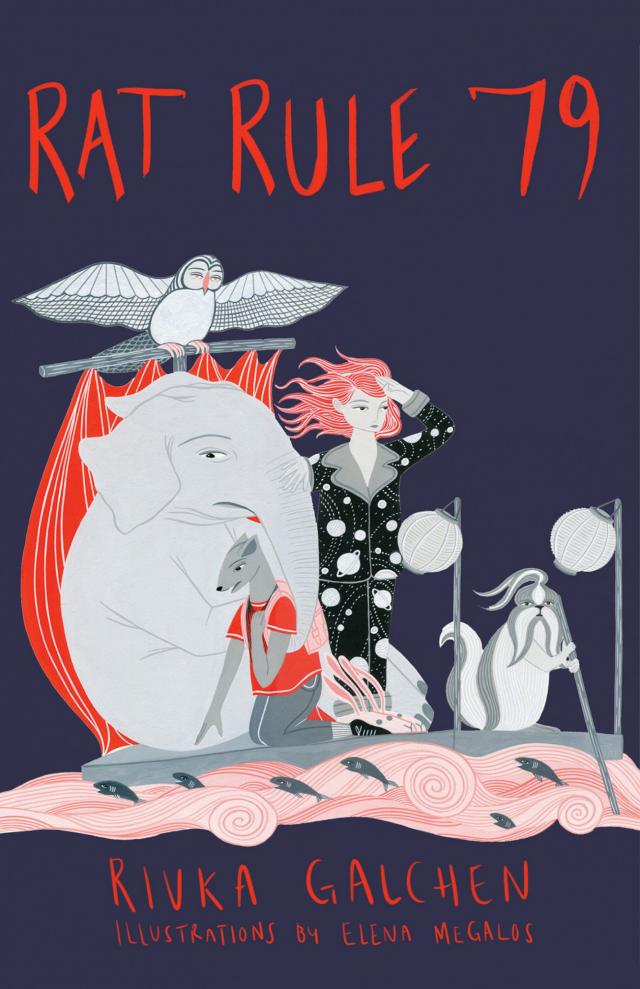
Rat rule 79, p.1
Rat Rule 79, page 1


Praise for
Rat Rule 79
“Rat Rule 79 is the adventure I didn’t know I wanted until it started, just like it’s the book you don’t yet know you’re going to love. We have been waiting for this book our entire lives.”
—Lemony Snicket, author of A Series of Unfortunate Events
“Rat Rule 79 is an impossibly perfect book: a Mobius strip where the love loops continuously between mothers’ daughters and daughters’ mothers, law and disorder, the lost and the found. Fred is a heroine for the ages—a twelve-year old savant of mathematical and emotional truths and a connoisseur of peanut butter and pickle sandwiches, Fred is smart enough to navigate irrational lands, demands, and numbers, and brave enough to love the strangest strangers. Rat Rule 79 belongs on a shelf of classics with The Phantom Tollbooth, Mrs. Frisby and the Rats of NIMH, and The Last Unicorn. How can it be that Galchen’s epic, so utterly, enchantingly new, also gave me the happiest deja vu while reading? How can the Dark, Dark Woods be such an illuminating place? These and other paradoxes fill Galchen’s astonishing, hilarious, mind-and-heart-expanding book. As I read, I thought, ‘I can’t wait to share this with my daughter, son, mother, brother, sister, best friend…’ a number set that eventually swelled to include: everyone.”
—Karen Russell, author of Swamplandia
“I love this book. It’s a wonder. I wish I’d had Rat Rule 79 when I was a boy. I’d have been obsessed with Fred and her adventures and reread her funny sweet story a hundred times, always finding something new.”
—James Gleick, author of The Information and Isaac Newton
“Lewis Carroll, Norton Juster, Tove Jansson, Russell Hoban; like them, Rivka Galchen has written a book for children and adults that occupies its own delightful and preposterous space. Rat Rule 79 feels like it has simply been waiting to fall into our laps.”
—Jonathan Lethem, author of Motherless Brooklyn and Chronic City
“Fred is a little bit Alice, a little bit Dorothy, but wholly original and smart, smart, smart. This is exactly how I like my wordplay. Can’t decide if I’m more enamored with the Insult Fish or the Elephant in the Room. Prime mother-daughter book club fodder.”
—Summer Dawn Laurie, Books Inc. (Berkeley, CA)
“Clever and fully entertaining, this humorous middle grade is perfect for parents AND young readers. I love the wordplay, the puzzles and the omnipresent narrator offering asides to the reader. Highly recommend!”
—Sarah Bagby, Watermark Books (Wichita, KS)
“Is there anything Rivka Galchen can’t do?! Rat Rule 79 is that book I always longed for as young reader, full of adventure, quirky characters, and short chapters. Speaking of which, the chapter headings alone are worth the price of admission and good for a few chuckles. The storytelling by Rivka Galchen is enough to keep you riveted, but the gorgeous full-page illustrations by Elena Megalos really bring the book to eye-popping life. I dare you to read the first forty chapters and not get hooked.”
—Javier Ramirez, The Book Table (Oak Park, IL)
“One of the most ingenious children’s books I’ve seen in ages. Full of intelligence, warmth, and wit. A page-turner in its own right!”
—Gary Shteyngart, author of Super Sad True Love Story
“Rat Rule 79 is a labyrinth of beauty, curiosity, and all things strange. Galchen effortlessly captures the chaos of being a thirteen-year-old girl; Fred is wild, half feral, both lost and found. I needed this book when I was a girl. I need this book as an adult. I will need this book when I am one hundred and thirteen.”
—Laura Graveline, Brazos Bookstore (Houston, TX)
“Rivka Galchen’s Rat Rule 79 is clever and strange and so very much fun, but what makes Rat Rule 79 so remarkable is the warmth and wisdom that exudes from its pages. A subversive Wizard of Oz for kids too smart for their own good, it’s sure to become many a young readers’ favorite book for years to come.”
—David Gonzalez, Skylight Books (Los Angeles, CA)
“A smart, witty through-the-looking-glass journey about a thousand unusual, interesting things and all the big important ones, too: home, friendship, holding on, letting go, and growing up.”
—Nicole Krauss, author of The History of Love and Great House
“I really enjoyed this book because of the non-stop humor and interesting/diverse characters. Fred is a girl who has had to move many times because of her mom’s work. When she moves to Twin Falls, ID, she stumbles upon a glowing lantern that ultimately leads her to a unique world where time is outlawed and no birthday parties are allowed…. This story was full of adventure and wacky chapter headings, too.”
—Alex, age 10, City of Asylum Bookstore Young Readers Board (Pittsburgh, PA)
“Witty, clever, and bright, Rat Rule 79 is a timeless adventure for readers of all ages. Filled with logic problems, riddles, and sharp wordplay, the Land of Impossibility is a place you will want to visit again, and again, and again. The characters are vibrant and unique, the prose is snappy and engaging, and the illustrations are whimsical.”
—Holly Roberts, Out West Books (Grand Junction, CO)
“Just beneath the surface story—which is chock-full of puzzles, jokes, antics, absurdities, and other delights—its heroine, the intrepid Fred, navigates a spiritual education in grief and love. Rivka Galchen has produced a book that somehow both sparkles and looms. Rat Rule 79 is an absolute treasure.”
—Sarah Manguso, author of 300 Arguments
“It has all the joys of The Phantom Tollbooth and Alice in Wonderland. It playfully exposes the holes in logic as presented through language. That sounds too snooty. It’s silly and deep at the same time with fun conundrums to ponder far beyond the last page.”
—Philipp Goedicke, Community Bookstore (Brooklyn, NY)
“Galchen creates an impossible land, filled with some charming creatures that help a 12-year-old girl find the right way to get back home. Danger and unreason are defeated by logic and love. Original and beautiful illustrations by Elena Megalos.”
—Pamela Pescosolido, The Bookloft (Great Barrington, MA)
Also by Rivka Galchen
Atmospheric Disturbances: A Novel
American Innovations: Stories
Little Labors: Essays
To the girl whose mother is my mother’s girl
Contents
Chapter Zero
Chapter Tuesday
Chapter Red
Chapter Redder
Chapter 12 364∕365
The Surprising Dungeon Chapter Without Assigned Number
Chapter Together
Chapter Sixty-One
Lucky Numbers
Chapter Seven Surprising Days
Chapter Thirty Minutes
Real Pickles
Nine Dots and Four Lines
Chapter Thought
Chapter Dot, Dot, Dot
Chapter Second Thoughts
Chapter Fork
The Know-It-Owl
Chapter Spoon
The Set of All Sets That Aren’t Your Set
Splitting Hares
Not the 91st Chapter
Too Many Birthdays Can Kill You
Negative Numbers
Zeno’s Chapter
A Round Tuit Chapter
At Nothing O’Clock
Picky Mouse’s Tale
Chapter Chance
The Present Chapter
Chapter Twelve Thousand Four Hundred and Seven, the Officially Most Boring Number in the World
Chapter √ –1
Chapter =
Chapter 1729
Real Numbers
Once Upon a Time
A Normal Chapter
A Middle Chapter
A Reasonable Chapter
A Rational Number
An Impossible Chapter
An Unwritten Chapter
Scale
A Sorry Chapter
The Technically True Chapter
The Other Chapter
What Does This Chapter Look Like to You?
Chapter Ate
The Empty Set
Interrogative Chapter
Chapter Grue
Nobody’s Chapter
Googol and Other Plexes
Next to Nothing
Fred’s Lemma Chapter
Square Two
The Perilous Querulous Chapter
chapter e
Hickory Dickory
- (-Chapter)
Chapter Thirteen
A Hartless Chapter
Law and Disorder
Horse Sense
A Hartfelt Chapter
Another Surprising Dungeon Chapter Without Assigned Number
Chapter One
Chapter Zero
Not long ago and not far away, in fact right here in the living room, there was a girl named Fred. Fred was not being chased by wolves. She was not battling an intergalactic clan of space pirates. She did not have ESP, she could not levitate, she was not an expert swordswoman, and she did not eat lightning. You might say Fred was a pretty normal girl—even if her favorite sandwich was peanut butter and pickles on raisin bread.
Even if nothing unusual had ever happened to her, I would care deeply about Fred. I would care about her simply because she was, and is, Fred.
Yet some unusual things did happen.
Chapter Tuesday
On a not particularly recent Tuesday night, Fred’s mom was setting the table: two paper plates on a red-and-white check tablecloth. Fred and her mother were getting ready to eat take out lo mein noodles—a happy fact, according to Fred. Fred’s mom was using paper plates because Fred and her mother were in yet another new apartment in yet another new city—an unhappy fact. In the last six years, Fred and her mom had lived in Wichita, Kansas; Boulder, Colorado; Iowa City, Iowa and Norman, Oklahoma. This was their first night in Twin Falls, Idaho.
Fred was sick of paper plates. She was sick of boxes, sick of packing and unpacking and repacking. She was bothered by everything about this bare and unfamiliar new room except her mother and the familiar red-and-white check tablecloth—the tablecloth that had traveled everywhere with them.
But still, the noodles were a happy fact. That was undeniable. According to Fred’s Unwritten Rule Book for Living, there were two Truly Great Meals. The first was the aforementioned peanut butter and pickle sandwich, especially when made with raisin bread. Wherever Fred’s home was, and however bare it was, she could almost always count on some peanut butter, some pickles, and some bread. They were her true friends.
The second Truly Great Meal was takeout lo mein noodles, because aside from being ultra-scrumptious, they always came with fortune cookies. Wherever Fred and her mom lived, they always managed to find a nice place to get takeout noodles. Noodles were also Fred’s true friends.
Fred took a deep breath, sat down, and resolved to be nice about being in the new apartment, in the new town.
Then her mother said: “What should we do for your birthday?”
Should I have mentioned this earlier? This particular Tuesday was the day before Fred’s 13th birthday.
Fred’s mom went on: “I thought maybe we could throw a party in a week or two, once the school year has started, since by then you’ll have some friends—”
“No,” Fred said.
“We’ll still do something tomorrow, just you and me. But—”
“No,” Fred said. “No party. Not tomorrow. Not in a few weeks. Not in the mood.”
Her mom smoothed the check tablecloth with her blue-veined hand. Finally she said, “I like that. No more birthdays. No more getting older.”
“That’s a dumb joke,” Fred mumbled. The noodles still tasted delicious. But as the ensuing silence between Fred and her mother grew longer, each noodle began to taste of a question. Why did her mom always just tell her they were moving? Didn’t she think she should ask her, Fred, if she wanted to move? She wasn’t a houseplant, she was a person. And even houseplants might have feelings. What did math professors—supposedly her mom’s job—really do all day? Why did her mom wear her hair in a ponytail so often? Why did she never buy Fred the correct size of clothes? Why was the phrase “birthday suit” so blech? Why had they never owned a cat?
These were angry questions, you will have noticed.
Fred said, “We never do anything for your birthday. I don’t even know when your birthday is.”
Her mom was picking at the last few snap peas and carrots among the noodles. “October 29th,” she said.
“Strange,” Fred said.
“What’s strange about the 29th of October? The 79th of October, now that would be a strange birthday.”
“It’s strange that your birthday date doesn’t even sound familiar to me,” said Fred.
They glumly finished off their delicious noodles.
“Fortune cookie time?” her mom said.
As everyone knows, the best of part of a fortune cookie isn’t the cookie itself. It’s what’s written inside, on the strip of paper, in delicate red letters. Except when the inside message is boring, like lottery numbers, or advice about being kind.
“You read first,” Fred said to her mom.
Her mom unfolded the slip of paper: “THANK YOU FOR GETTING ME OUT OF THERE!”
“Weird,” Fred said.
“Your turn,” her mom said.
Fred’s fortune cookie message was even weirder. She read out loud: “LIFE IS TWO LOCKED BOXES, EACH CONTAINING THE OTHER’S KEY.”
“Two locked boxes?”
“That’s what it says.”
“Huh. That’s odd. Though it sounds familiar somehow.”
“It’s not even a fortune!” Fred complained. “Even the fortune cookies in this town are annoying.”
Her mom started clearing the table. Fred didn’t help. Her mom said, “You’re tired. You’ll feel better after you sleep. It’s amazing how many problems are solved by sleep.”
Sleep! What a dumb suggestion. Sleep was just a kind of nothingness. How could a few hours of nothingness solve anything? Another entry in Fred’s Unwritten Rule Book for Living was that sleep as a solution to anything was one of the Two Most Useless Solutions. The other most useless solution was Knowing That You’re Loved. If Fred were to ask her mom what two plus seven was, Fred was sure her mom would answer either Sleep, or Know That I Love You So Much.
“I’m not tired,” Fred said. “And you’re ignoring the elephant in the room: I have nothing and nobody here.”
“Well, that’s two things—Nothing and Nobody,” Fred’s mom joked, her back to Fred. She was tying up the trash. She turned back toward Fred and said gently, “Know that I love you so much, Fred.”
“I knew you would say that,” Fred said bitterly.
“Tomorrow will be a better day.”
Fred laughed a small, unhappy laugh. “My birthday, you mean?”
Her mom said nothing.
“Good night then,” Fred said in a fury. And she stormed off to her small, near-empty new bedroom, where there was only a mattress on the floor and her old moon-shaped night-light plugged into the wall. There she sat, wide-awake, cross-legged, and very, very mad.
Chapter Red
Dear reader, perhaps you’ve been conscripted into the Sleep War. It’s a war between those who despise sleep (most kids) and those who are devoted to sleep (just about every adult.) Which is backward if you think about it, since adults are the ones who consistently tell perfectly awake kids to go to sleep while they themselves, the supposedly sleep-worshipping adults, stay up and up and up. I won’t mention which side of the Sleep War I’m on, in part because there are ways to be on both sides of a line at once, for example, by being the line.
But back to the point. Fred thought her mom’s advice to get some sleep was so wrong, and so clueless, and so infuriating, and so…. Well, the very thought of it kept Fred awake. Awake and angry. So awake and so angry that she resolved that she definitely would not sleep until her mom came into her room and apologized to her. Oh, yes. She would wait for her mother to walk into her (new, small, empty, horrible) bedroom and say Sorry. Right there in the wavering glow of the night-light moon. Fred was willing to wait forever for her mother to apologize to her for the dumb idea that sleep (or love, or whatever) would make her feel better. And maybe for other things, too. For the irritating seam on her socks. For the way humidity made her ears feel itchy. For the name “Fred.” For the excruciating-ness of introducing one’s self, over and over and—
Chapter Redder
However: Fred’s mom continued not coming into Fred’s room to apologize. What was she doing out there? Did she expect Fred to stay up nearly forever waiting, like a giraffe? (Fred knew that giraffes sleep only about thirty minutes a day, standing up.) It was so quiet out there. Weirdly quiet. Was her mom staring at a computer screen again? Doing her “work”?
Often Fred was right when she made guesses about what her mom was doing, just as she was often right when she made guesses as to what her mom was going to say. They knew each other very, very well, even though an adult and a child are like two different species. On this particular evening, though, Fred was wrong.
I’m a fan of being wrong. At least now and again. Being wrong is often the first sign that you’re about to learn something new. You might say that being wrong is the first step of an adventure. Or you might say that this is the kind of irritatingly chipper and totally unconvincing thing Fred’s mom might say.
Fred opened the door and saw her mom in the living room. (Not surprising.) Standing with her back to Fred. (A little bit surprising that she was standing up, almost as if at attention.) Staring at an enormous white paper lantern. (That was a very big bit surprising, the paper lantern part.) Fred had never seen this lantern before, or any lantern of its kind. The lantern reached nearly to the ceiling and was even wider than it was high. It reminded Fred of that accordion paper you get after scrunching down the wrapper of a straw. You scrunch down the straw wrapper, then drip a drop of water on it and watch the wrapper grow, like a magic paper snake. Why was Fred thinking about that at a time like this?