

The time bunker, p.1
The Time Bunker, page 1


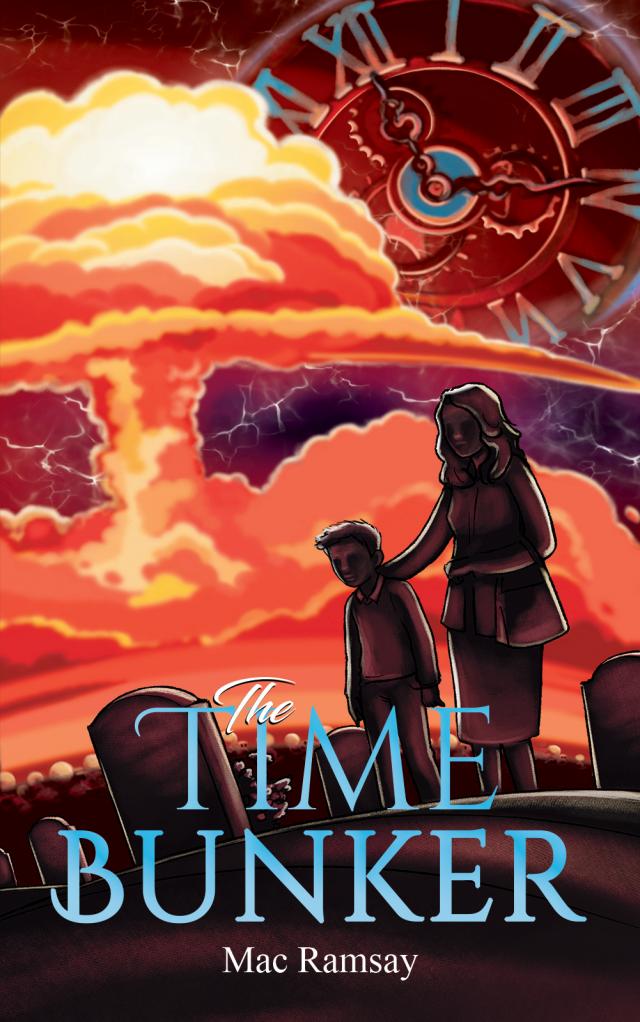
The Time Bunker
Mac Ramsay
Austin Macauley Publishers
The Time Bunker
About the Author
Dedication
Copyright Information ©
Acknowledgements
Chapter 1: April 12th, 2010
Chapter 2: MOD
Chapter 3: Preparation
Chapter 4: About Time
Chapter 5: Owen Milburn
Chapter 6: TDM User’s Manual
Chapter 7: Alone
Chapter 8: First Attempt
Chapter 9: Cause, Effect and Consequence
Chapter 10: The First Journey
Chapter 11: Angelo Villan
Chapter 12: Consequences
Chapter 13: The Time Traveller
About the Author
Mac grew up on a farm in Yorkshire. At 18, he moved to London to complete his teacher training and remained there for 12 years. Whilst living in London, Mac became interested in filmmaking, attending the Metropolitan Film School and wrote/directed his first short film at the age of 26. He has also directed a number of music videos. Following the birth of his first child in 2010, Mac returned to Yorkshire. He developed his love of storytelling whilst working as a primary school teacher, realising the importance of story in a child’s life. Besides, writing and filmmaking, Mac is a multi-instrumentalist, playing in a variety of bands across the area.
Dedication
In memory of George Ramsay (1952–1997). If only time travel were possible.
Copyright Information ©
Mac Ramsay 2022
The right of Mac Ramsay to be identified as author of this work has been asserted by the author in accordance with section 77 and 78 of the Copyright, Designs and Patents Act 1988.
All rights reserved. No part of this publication may be reproduced, stored in a retrieval system, or transmitted in any form or by any means, electronic, mechanical, photocopying, recording, or otherwise, without the prior permission of the publishers.
Any person who commits any unauthorised act in relation to this publication may be liable to criminal prosecution and civil claims for damages.
This is a work of fiction. Names, characters, businesses, places, events, locales, and incidents are either the products of the author’s imagination or used in a fictitious manner. Any resemblance to actual persons, living or dead, or actual events is purely coincidental.
A CIP catalogue record for this title is available from the British Library.
ISBN 9781398437241 (Paperback)
ISBN 9781398437258 (ePub e-book)
www.austinmacauley.com
First Published 2022
Austin Macauley Publishers Ltd®
1 Canada Square
Canary Wharf
London
E14 5AA
Acknowledgements
Natalie, you didn’t hesitate in insisting I ‘go for it’ and for that I am eternally grateful. Thank you ‘Fearnes’ for giving me such amazing feedback and encouragement; I sincerely hope you enjoy the final thing. Val, the best mum, dad, nana, friend, loan shark, counsellor and child minder on the planet. Your support over the years has been invaluable.
Chapter 1
April 12th, 2010
It was the darkest day he could remember. The day most people only experience in nightmares. St. Mary’s Church was crammed with the devastated faces of mourners dressed in black. Angelo Villan was a popular man and his sudden and premature death, as the result of a motor-cycle accident, had shocked the community. He, his pregnant wife Marie and 4-year-old son Noel, lived in a picturesque town in the Yorkshire Dales, where Angelo himself had lived since childhood.
Angelo was a motorbike enthusiast – a real petrol head. It was a warm Sunday evening in spring when he had decided to take his motorbike out for a spin around the windy roads of Nidderdale, as the hard-core biking community often did. It helped him to relax and gather his thoughts before beginning a new week running his motorcycle repair garage, ‘Hawkins,’ which was situated on the outskirts of town.
Up in the dales, the roads are narrow and windy, but Angelo knew them well and rode confidently. However, the driver of a car coming from the other direction was not so careful, and had hit him head on; killing him instantly. According to rumours, the driver, a teenage boy who had not long since passed his test, was on the wrong side of the road and may have been looking at his phone as he drove. What a waste. Angelo died because some kid couldn’t wait to read a message.
People would often say that Angelo was lucky because it would all have been over with before he even had time to think. Noel certainly didn’t feel lucky. Up until that moment, he had believed his dad was invincible.
Noel’s mum was a teacher at the local primary school and always seemed to be busy. ‘Teachers are always cross,’ Noel used to think, ‘Who would ever want to be one?’ It was Angelo who had brought up Noel during those formative years. His mum had a steady job and so went back to work soon after his birth; Angelo postponed his career to raise his son. It wasn’t until after Noel’s 3rd birthday that he took the plunge and opened his own garage, his dream business. For the four years that Noel spent with his father, they were inseparable, but now he was dead and he wasn’t coming back.
Many people came to pay their final respects to the deceased man, including a large population of hairy tattooed bikers, dressed in black leathers. At the funeral, the church was so full, there was standing room only. Noel Villan walked behind the coffin with his mother who wept uncontrollably, for the love of her life. All he remembered of that dark day was black clothes and sad faces. He was only four and didn’t understand until much later that his dad would never be coming home. He was told by his mother that his dad had been very badly injured on his motor-bike and would now be living in heaven with God. He couldn’t remember the word ‘dead’ being used until much later.
Noel’s last memory of his father was his voice calling from the front door as he left to ride his motorbike, “I’ll be back in an hour or two.”
The engine started and faded off as he rode away from the house. And that was it– he was gone. Forever.
Chapter 2
MOD
I don’t remember the exact date I discovered it, but I know it was definitely sometime in late August because it was during the school summer holidays. Obviously, I had no idea what it was to start with. On the edge of our town is a wooded area known locally as ‘the forest.’ It isn’t actually a forest – it’s much too small, but it’s big enough, and has enough trees to have adventures in. Myself and my best friend Aaron, would often play in the forest. It was a great place to do things that you didn’t want your parents to find out about. Our favourite thing to do was to light campfires. I wonder why boys are so fascinated by fire – I have never met a boy who isn’t.
I would steal boxes of matches from the kitchen cupboard and Aaron would bring a fire-lighter or two. In the summer, when the fallen branches are tinder dry, it is easy to get a fire going. We would often light one and just sit there staring into the flames, lighting sticks and watching them glow as the breeze passed around them. We would talk about all sorts – girls mainly, but often bigger questions. What is the meaning of life? Is there a god? Why do people have to die?
We would also find dried plant stems and pretend they were cigarettes. There is a certain type of thistle that, when it dies and dries out, the stem becomes a hollow brown tube. We would light the end in the fire and when it was smouldering, we’d put our lips around it and suck. It was the single most disgusting taste in the world, and we would hack our lungs up when we inhaled the smoke, but boys of a certain age will do pretty much anything to impress each other and we were no exception.
It was during the summer holidays, and I’m fairly sure it was a Saturday, when I first made the discovery that would quite literally change history.
Aaron was with me. We were in the forest, throwing stones at a discarded beer can that we had hung from the branch of a tree by passing a length of string through the ring pull. For ages, we just sat on the ground, unearthing small pebbles and lobbing them up at the hanging can. It’s amazing how much entertainment you can achieve from such a simple game. I liked the sound it made when you hit it – a satisfying crunch. I’d hit it four times and Aaron only twice, so I was in the lead.
I remember the unusual noise vividly. I threw a rock-probably the largest I’d thrown that day. It missed the can and as it landed, it made a clanking noise rather than the thud you’d expect from a large rock hitting the forest floor. It had hit something heavy and metallic.
It startled us enough to make us both sit up. We looked at each other and said nothing for a second or two.
“That’s weird,” Aaron remarked, “Did you hear that? Let’s take a look.” I agreed and armed with sticks, we fought our way through the knotty undergrowth; the tangle of thorny bramble branches scratching our legs as we did so.
I spotted it first. Hidden beneath a knot of entwined forest shrub, was a circular, rusty, metal disc on the ground. It was about the size of one of those large hula-hoops that teachers use in PE lessons at primary school. At first, I thought it was laid on top of the ground but on closer inspection, I realised that on one side, there were hinges and on the opposite side, a handle. It reminded me of a manhole cover; the type that you find in gardens to access the sewage pipes. Embossed in the centre were three letters; MOD, followed by the words, ‘DO NOT ENTER.’
“I wonder what MOD stands for,” commented Aa ron looking at me to see if I knew.
“I don’t know; perhaps it’s some sort of access to the drains,” I replied.
“In the middle of a forest?” Aaron was sceptical. There would be no reason to run drains through the middle of a forest, to which I agreed.
The cover looked heavy, but it didn’t appear to be locked.
“We should open it,” I suggested.
Aaron looked down at the words and pointed whilst reading them out, “Do not enter.” He then looked back at me as if to dismiss my suggestion.
“But nobody’s looking.” I reassured him that we could have a quick look, but Aaron wasn’t convinced.
“No. It might be dangerous.” We had both seen the films they show you at school, the ones where the children try to retrieve a ball from an electricity sub-station and end up dying from electrocution.
“We need to find out what MOD stands for,” Aaron cautiously suggested. “It could mean anything. Mental Otter Den?”
We both chuckled. I bent down and took hold of the handle to see if I could lift it. It did move a little, but it was too stiff and heavy to lift fully on my own. I asked Aaron to give me a hand and he gave in. I lifted it enough by the handle for Aaron to get his fingers underneath and we managed to lift it just enough for Aaron to see inside before he shouted out something about his fingers hurting and let go – the metal cover slammed shut with a clank.
“What did you see?” I quizzed, “What was down there?”
Aaron was inspecting his hands – blowing on them and rubbing them together. They were indented and coloured red and white where the heavy cover had been pressing down on them.
“It went straight down,” he told me.
“There was a strange ladder.” He described the sort of ladder, which isn’t really a ladder but individual metal rungs concreted into the side of a wall.
“I wonder where it goes,” he added, “I couldn’t see the bottom.”
“We should try again,” I told him, but he seemed less than keen.
I was surprised at how apprehensive he appeared. Aaron was normally quite keen when there was mischief to be had so I knew that he must be genuinely unsure about it.
I took the handle and pulled again without consulting him; a kind of I’ll-do-it-without-you-then statement. I strained with the weight of it, my face contorting.
“Put something underneath,” I told him. He lifted a branch off the forest floor, wedging it under the cover so that it didn’t shut fully when I eventually had to drop it again due to the weight. I readjusted my position. I laid on my back and used my feet to push it up further while Aaron moved the large branch nearer to the hinges, so it was eventually wide enough to peer into and even enter if we had the guts to do so.
We both looked in. “I’m worried the branch won’t hold,” Aaron admitted. “It’ll cut us in half if it drops on us.”
I told him to shush and stop exaggerating whilst I examined the inside. Luckily, the sun was high in the sky, so it shone almost directly down into the abyss. It was a long vertical tunnel that led straight down.
As Aaron had said, there were metal rungs all the way to the bottom so that people could climb down. There was obviously something down there. It was quite a long way, but you could see that at about 20 feet, there was solid ground.
The shadows made it too hard to see if there was anything else, but I reasoned that there must be. Why would someone dig a hole in the ground and take the effort to concrete rungs into the side and then cover it up?
We would have to climb to the bottom to get a proper look.
“I think this may be some sort of air-raid shelter,” I told him.
“A what?” he asked.
“An air-raid shelter. They were built during World War 2. My great-granddad used to have one in his garden.”
Aaron still didn’t seem to know what I was talking about, which was frustrating because he was sat in the same history lesson in Year 6 when we built them out of Papier-mâché. He shook his head to indicate that he didn’t know what I was talking about.
“We built them in Year 6!” I was growing impatient, but I was determined to get him to remember, “Air raid shelters!”
“I thought they were called Anderson Shelters.” Finally, the penny had dropped.
“Yes!” I was relieved the line of conversation was over. “It’s the same thing. Anderson Shelter; Air-Raid shelter. They’re just different names.”
“I think perhaps we should give it a miss,” Aaron suggested. He was definitely not keen on going down.
“Besides, we’ll need a torch. And we need to know what MOD stands for. Whatever’s down there – Mental Otters or anything else – we should be cautious.”
“Mental otters would be cool though,” I added, trying to drop in a little humour. Aaron half smiled at my attempt. I continued, “We shouldn’t tell anyone about this. If it is an air-raid… sorry, ‘Anderson’ shelter, it could be huge down there. Do you remember the pictures in Mr. Truman’s lesson? They weren’t all tiny shacks built out of old sheets of metal. I’m fairly sure some were built to house entire villages and towns. It could be awesome down there. If we tell anyone, they might seal it off.”
Aaron didn’t say anything. I could see he was deep in thought. “That cover worries me,” he mumbled.
“Why?”
“If we’re in there and it happens to shut, how do we ever hope to get out? Nobody would know where we were.”
He had a point. The cover closing whilst we were inside was a definite possibility. I didn’t want to end my days starving to death at the bottom of a hole in the middle of a forest. However, I was a 13-year-old boy and when did you ever hear a story where a 13-year-old boy did the sensible thing?
“I have an idea,” I declared. Aaron looked at me waiting for the solution. He was no longer dismissing the possibility of entering the hole. Curiosity was getting the better of him. I could tell I could twist his arm and we would be investigating this hole in the ground before too long. I just needed to reassure him a little bit more.
“We need provisions and we need to make it safe.” I went on to explain to Aaron how we would not enter the hole today. We would go home tonight and pack food and drink. We would also find something stronger than a tree branch to wedge the heavy cover open.
Aaron’s two main anxieties were the door closing, trapping us inside and consequently, the pair of us starving to death. If I could reassure him that this would not happen, I knew I could get him to enter the hole with me.
Aaron and I covered the entrance to the hole with leafy branches to avoid anyone else discovering it before we’d had a chance to explore. We walked back into town together and mooched around outside the shops for a little while before heading back to our separate homes. We both agreed to pack a rucksack with food and drink. I had agreed to look for something strong to wedge open the cover more securely. Dad had been dead for nine years and we had moved to a new house since then, but Mum had kept hold of all his motorbike kit. She couldn’t bring herself to get rid of it. We had a garage full of bits and pieces – it was like a shrine to Dad. I was sure I would find something in there.
“Alright Love?” This was Mum’s normal greeting. She was a proper Yorkshire lass and despite living in the Dales for most of her adult life, she still had the broad accent from her childhood in Leeds.
“What you been busy with?” She had her back to me. She was getting dinner ready and was too busy to stop and look at me as she spoke.
I went on to tell her that Aaron and I had been playing in the forest, which was no great surprise. It was where we spent most of our time when the weather permitted.
She plated up our dinner, warned me that it might be a little hot and we sat and ate at the kitchen table.
“Mum, what does MOD mean?” I asked as we sat there eating. Her brow furrowed as she thought for a few seconds.
“It can mean different things,” she replied. “If you mod something, it means you modernise it. You customise it and make it better. Dad was always going on about ‘modding’ his motorbike.”






