Dolls eye, p.1
Doll's Eye, page 1


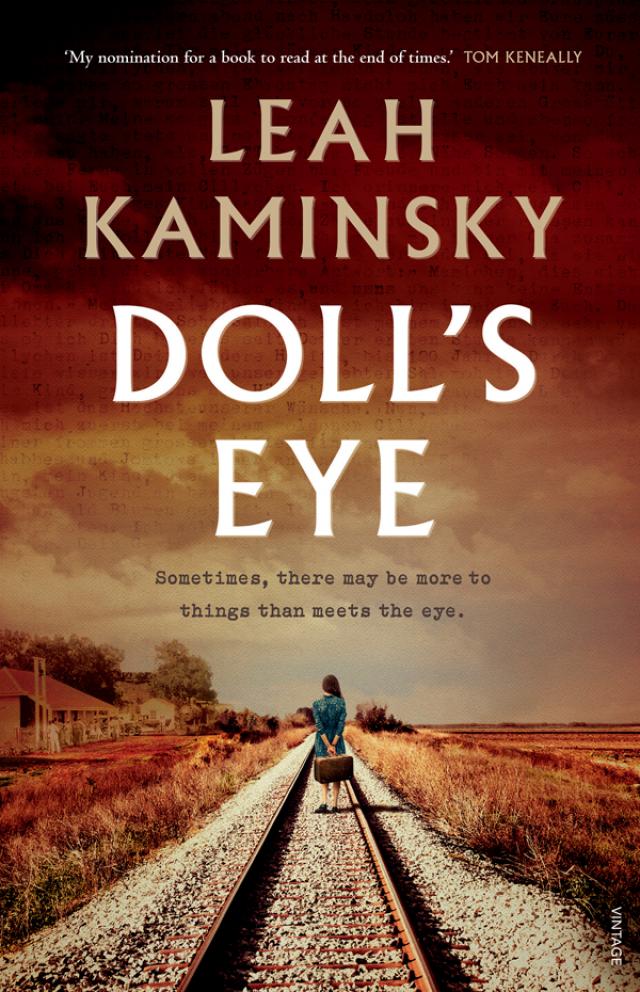
About the Book
GERMANY, 1933.
Anna Winter returns home to find a note from her father, warning her of grave danger. She flees overnight, taking her precious doll collection with her, and sets sail for Australia. She lands a job at the Birdum Hotel and carves a new life, hiding her past from the world – until a chance encounter with an eccentric stranger, Alter Mayseh, changes everything.
AUSTRALIA, 1938.
A Yiddish poet fleeing persecution, Alter has seen the writing on the wall for his people. Armed with a letter of introduction from Albert Einstein, he escapes Europe and arrives in Australia in search of a safe place to call home. When fate leads him to Anna, he’s convinced he’s found his future with her. But a disturbing clue to her dark past threatens to unravel the delicate life she has built on top of the secrets left behind.
Shifting in time and place, Doll’s Eye weaves an intriguing story of love, loss and survival against a backdrop of war and displacement. Evocative and compelling, it brings into question the gap between what we see, and what we don’t.
Contents
Cover
About the Book
Title Page
Dedication
Epigraph
Author’s Note
Prologue: Carlton
Part I
Chapter 1: Birdum
Chapter 2: Warsaw
Chapter 3: Birdum
Chapter 4: Birdum
Chapter 5: Port Phillip Bay
Chapter 6: Birdum
Chapter 7: Munich
Chapter 8: Birdum
Chapter 9: Landsberg
Chapter 10: Birdum
Chapter 11: Landsberg
Chapter 12: Birdum
Chapter 13: Landsberg
Chapter 14: Birdum
Chapter 15: Munich
Chapter 16: Birdum
Chapter 17: Birdum
Chapter 18: Birdum
Part II
Chapter 19: Munich
Chapter 20: Landsberg
Chapter 21: Katherine
Chapter 22: Munich
Chapter 23: Katherine Gorge
Part III
Chapter 24: Melbourne
Chapter 25: Carlton
Chapter 26: Carlton
Chapter 27: Tatura Internment Camp
Chapter 28: Carlton
Chapter 29: Carlton
Chapter 30: Carlton
Epilogue: Carlton
Acknowledgements
About the Author
Also by Leah Kaminsky
Imprint
Read More at Penguin Books Australia
For Maia, Ella, Alon and Yohanan Loeffler
In memory of William Cooper (1860–1941), a Yorta Yorta man who, upon hearing of the events of Kristallnacht in Europe in 1938, was so outraged by the outburst of hatred and violence against Jews in Nazi Germany that he organised a march of First Nations peoples, leading a delegation to the German consulate in Melbourne. Cooper was turned away when he tried to present a letter condemning the persecution of Jews. This was among one of the first international protests against the atrocities perpetrated by Nazi Germany against the Jewish people.
Dos oyg is azoy kleyn, dokh zet es di gantse velt.
The eye is so small, yet it sees the entire world.
Yiddish proverb
Doll’s Eye – a reflex used to determine whether a patient is conscious.
AUTHOR’S NOTE
The locations in this work of fiction take place on country of the Yangman nation, the Jawoyn, Dagoman and Wardaman peoples and the Wurundjeri people of the Kulin nation. I respectfully acknowledge the Traditional Owners of these lands. First Nations peoples were the first storytellers here. I am grateful for their generous assistance in the writing of this work and thank them for welcoming me to Country. Sovereignty of this land has never been ceded.
PROLOGUE
CARLTON
1949
Anna Winter tore off her patient’s head and lay it on the table. Tugging at the straw-like hair, she turned the head around. One eye stared back at her, blue and unblinking. Fishing some surgical pliers from the pocket of her starched laboratory coat, she pulled the lid of the other eye until it flipped open to reveal an empty crater. She ran her fingers over the pouty baby-face, fractured nose and rosebud mouth. Even though its body was battered and broken, Anna could see how much her patient had been loved. Cradling the cracked porcelain head, she dunked it into a tub of water. The remaining eye looked old, made of hand-blown glass. Luckily, it was still intact. Eyes like these would be difficult to replace.
‘Her name’s Betty.’
The client, her narrow lips pursed, stood on the other side of the table, like a student in the first row of an anatomy dissection. She stared owlishly at her beloved doll as Anna gently cleaned out the eye socket with a cotton swab. The raw-faced woman’s life story began to ooze out.
‘I’ve had her since I was four.’ Her voice turned squeaky. ‘That’s sixty years.’
Anna glanced up.
‘She was a gift from my nanna when Mother died.’ A tear trickled down the woman’s cheek. She explained the family dynamics, her dreadful marriage, her return to part-time work in a bakery after the children left home. As Anna listened to the litany of sorrows, she lay the doll’s head back down and used a felt cloth to dry it carefully.
They all ended up telling her their stories; tragedies and joys spilled out into the chalice of her silence. There was the butcher’s teddy bear, who had been left with him in a basket when he was abandoned on the doorstep of an orphanage as a newborn. Its smile had worn away over the years and he wanted it repaired. Or the toy soldier with a broken gun, belonging to a high-ranking bank official who carried it around in his briefcase for good luck. And every Friday morning the widow who lived up the street brought in her melancholy Raggedy Ann. Anna always helped lift the doll’s mood by having a cup of tea and some home-baked biscuits with its owner. Tiny doll-souls absorbed everything, observing without seeing. A world of secrets stayed locked inside those eyes.
She reached for a box of glass orbs that rested beside her, each one cupped in its own small silken nest. They ranged in colour from greyish-green to blue and brown. She needed to get the eyes right. If they were disproportionate or had lids that blinked with an overly mechanical click, it made the doll look insensitive.
Choosing a blue eye for Betty that matched almost identically, Anna inserted it carefully into the socket. The customer, clutching her handbag, hovered closer. As the doll doctor slid the eye into place with a pair of forceps, the woman gasped:
‘Don’t hurt her!’
Anna flinched. The doll’s eye suddenly slipped from her hand, clattering onto the floor, as though a flicker of life was ignited and it was trying to escape. The blue orb rolled away with the force of a marble and smashed against a metal shelf. They both watched in horror as it shattered into tiny shards.
Anna was not used to having someone watch her as she worked.
‘Would you please leave?’ she snapped with startling force, ushering the woman away with her free hand.
Betty’s owner wiped a tear from her cheek and cleared her throat.
Anna feigned a smile and tried to soften her tone. ‘If you would kindly come back later this afternoon, it would give me more time to pay closer attention to Betty. As you can see, it’s a very delicate procedure.’
The woman picked up her handbag, straightened the front pleat of her skirt and scurried out of the shop. The bell tinkled as she closed the door behind her. Anna made a point of never asking how the damage to a doll had occurred. Most of the time clients would volunteer the gruesome details themselves, but Betty’s owner, for all her babbling, had omitted the story of the doll’s demise.
The workshop looked like a small amphitheatre, each wall lined with shelves that stretched all the way up to the ceiling. They held a galaxy of broken toys, some with disfigured faces, others suffering from unstrung limbs or missing teeth. The dolls ranged from expensive antique collector’s items to those that merely looked like a dressed-up sock with limbs crudely moulded out of wax. A ceramic squirrel, missing a paw that once played a mandolin, leaned against a red-haired monkey smoking a broken pipe. A giraffe with a bent neck towered over a toy bishop who wore a torn cassock. Some of the dolls were hideous and beyond repair, black mould lining the edges of their pink mouths. Fixing each one involved a large degree of versatility and inventiveness. But repair always went far beyond the mere tinkering with a physical object. A true doll doctor restored the client’s most treasured childhood memories. Discretion was meant to be paramount in Anna’s profession, but this morning her patience had shattered along with the doll’s eye.
People travelled to her from all over the country. Although there was no sign outside the workshop, those who sought her out seemed to somehow find their way instinctively to her door. Men would stand at the counter shuffling from one foot to the other, their cheeks reddening as they pulled moth-eaten toy dogs out from duffel bags. Old women cradled lifelike baby dolls swaddled inside the folds of crocheted blankets, and trembled as they handed them over. Anna had seen it all. How they whispered their goodbyes, planting secret kisses on treasured plastic cheeks and stiff woollen curls before leaving. Some would stay too long, like this morning’s client, stories spilling out onto the long, oak surgical table that was littered with doll flotsam and body parts. Chubby legs and dimpled porcelain arms, splayed out and distorted, looked like they had dropped off some contortionist suspended m id-air. A shelf at the back of the workshop housed dolls that had simply been abandoned, their unfortunate fate sealed as they transitioned from being treasured companions to spare parts. Others, resurrected from the dead, carefully cobbled together from Anna’s mortuary detritus, were reanimated into little human lookalikes.
Anna knew her customers were searching for their childhood, and like a true alchemist she distilled something from nothing to bring back those hidden moments of memory. The fleeting vision of a mother leaning over the bed, holding her palm against a child’s feverish forehead to chase away the bogeyman of the dark, or a myopic uncle peering over the edge of his spectacles, his fingers gripping a chubby cheek in a pincer hold.
Surgery began again. Placing some glue onto the back of another glass eye that had a greyer, steelier hue, she slotted it inside the gaping socket. She gazed at Betty’s two eyes staring back at her and felt a strange joy in their glassy silence. Anna preferred the company of dolls – they asked no questions. Instead, they just waited patiently inside her workshop – eternal brides adorned with yellowed veils, seated next to ambulance drivers ready to tend to the wounded. The debris of doll accessories – a Wunderkammer of broken prams, miniature houses, wigs made from human hair, leather boots and knitted clothing all piled into trays was everything that could ever be needed for a doll’s comfort.
In the far corner of a top shelf sat a homely doll wearing a faded gingham pinafore, white anklet socks and black party shoes. Her name was Lalka, and she watched Anna’s every move. Lalka was a remnant from her own childhood, an ambassador from the world of things and a memory of the dead – a parting gift from Mutti. To the outside world she had always been known as Lali. Anna cherished her first doll the most, even though those that came after were all poetry and precision by comparison.
Anna set her client’s broken doll aside, waiting for the glue to dry. An earless bunny lay on the operating table, next in line for repair. It smiled blandly. Thankfully, this would be a quick job. An ear could be perfectly replaced, reattached where there is nothing important underneath. Eyes, though, demanded time, as Fraulein Schilling from the Puppetarium had taught her all those years ago. They were the essence of a doll, the all-seeing holders of secrets. And always the hardest part to mend.
She was about to pack up and head upstairs when she heard someone knocking at the door.
PART I
Di velt iz a groyse un s’iz zikh nito vu ahintsuton.
The world is huge and there’s nowhere to turn.
Yiddish proverb
CHAPTER 1
BIRDUM
FRIDAY 23RD SEPTEMBER, 1938
It was a small town, if you could call it that, tucked away like a hidden blemish on the underside of the world. Anna walked along the veranda of the hotel, its white, wrought-iron frame shimmering against the red earth. Even though the sun had set, the heat still felt stifling. Keys jangling in her hand, she fiddled with the rusty lock until she heard a familiar click. Strange really, this ritual of safekeeping – as if any thief around here could make a quick getaway. The wooden door creaked as it opened, the handle glaring at her with forlorn brass screw eyes. The last of the stragglers had wandered off to bed. Time to tidy up. She stepped into the dimness of the bar, setting a beer bottle rolling across the room. It rammed up against a large cabinet, rattling a collection of world globes.
Tell-tale fingerprints on the cabinet glass showed that Anna was a frequent visitor to this ersatz museum. She slid open the panel and sent one of the globes spinning. The world became a blur, borders losing their definition. Countries chased each other clockwise around the tilted axis of a globe. With one finger she stopped them abruptly, then on a whim sent them hurtling off in the other direction. Instead of Australia following the rest of the world, she changed the rules and sent Paris, Rome and Berlin off in search of Birdum.
When she first arrived at the hotel, she was puzzled by these orbs. Why would anyone who chose to live in a place so remote hoard so many worlds? She soon learned this very town was the reason the collection took pride of place in Tom O’Hara’s pub. If you looked very closely, right there in the centre of the large continent, you could make out the fine, black letters: B-I-R-D-U-M. Latitude 16 degrees 13' 55" S, Longitude 133 degrees 12' 04" E. Several years earlier the town had started to appear on world globes, reaching diminutive international fame thanks to its position as the final terminus for the North Australia Railway. Situated at the end of the line, Birdum prodded its way like some blind feeler groping into the heart of the land.
Heralded by a pair of wooden beams, Birdum station was hardly the Munich Hauptbahnhof. The weekly steam train, known affectionately as Leaping Lena, shunted travellers to and from the city of Darwin – a gruelling 320 miles to the north. After it traversed the 100-yard bridge at Birdum Creek, Leaping Lena announced its arrival with a clamorous shriek that drowned out its rhythmic groaning.
The locals would come out to peer at the train’s dark shape approaching along the rusty narrow-gauge tracks. Finally emerging from the surrounding scrub, the locomotive, followed by two obedient carriages on enormous wheels, rattled along the rails, coming to rest on a turning triangle beside a dusty platform. It billowed black smoke into the air before winding down with a loud wheeze. Limping dogs that lounged under the shade of a veranda, occasionally snapping at flies, were always the first to hear the train approaching in the distance. Everyone stopped what they were doing, or rather, took a break from doing not very much, and made their way over to the wooden platform where Leaping Lena prepared to disgorge her passengers. A lonely timetable was tacked to the side of a rickety railway hut:
Depart Darwin 8 a.m. on Wednesdays
Arrive at Pine Creek 4.46 p.m.
Depart Pine Creek 8 a.m. on Thursdays
Arrive at Katherine 11 a.m. on Fridays
Depart Katherine noon Fridays
Arrive at Birdum 5.51 p.m. Fridays
Earlier that evening Anna had sauntered across to join Leaping Lena’s welcoming committee. The dogs whipped into a frenzy, except for Gubbins, who grimaced like a cranky old man. From the moment Anna had arrived in Birdum Gubbins started following her around, grateful for the scraps of bread and greasy victuals she threw his way. He would drag himself out from under the table, his unclipped claws scraping across the wooden floor, and hold out his paw like a tired beggar. His ribs were fine and delicate beneath mottled patches of fur. Staring at her, he would cock his head expectantly until she threw him a bone. There must be no better way to see the hidden secrets of a town in the outback, she thought, than through the eyes of a dog.
People usually spilled out from Leaping Lena and stood there speechless, surrounded by a few stunted trees drowning in a sea of tall grass, beneath the dome of twilight sky. Sticky from oppressive heat and humidity, the dishevelled passengers slumped their suitcases on the platform. The train was soon unloaded by workers who stacked up its cargo on the rickety platform. It didn’t take long for the railwaymen, driver and passengers to walk past the row of huts scattered along either side of a lonely dirt road. They all ended up in one place – the Birdum Hotel, which stayed open late on train days.
The hotel was the most imposing building in town. Beyond its broad veranda it was a typical pub, with a few tables and chairs scattered around the entrance and rusty barstools hugging the counter. Several snake skins decorated the door frame. An old upright piano was huddled in a dark corner, its broken keys yellowed like an old man’s teeth. A dried-out stuffed crocodile was splayed out along one wall, with its open jaws poised above a dusty patron who was focused on his tenth beer for the day.