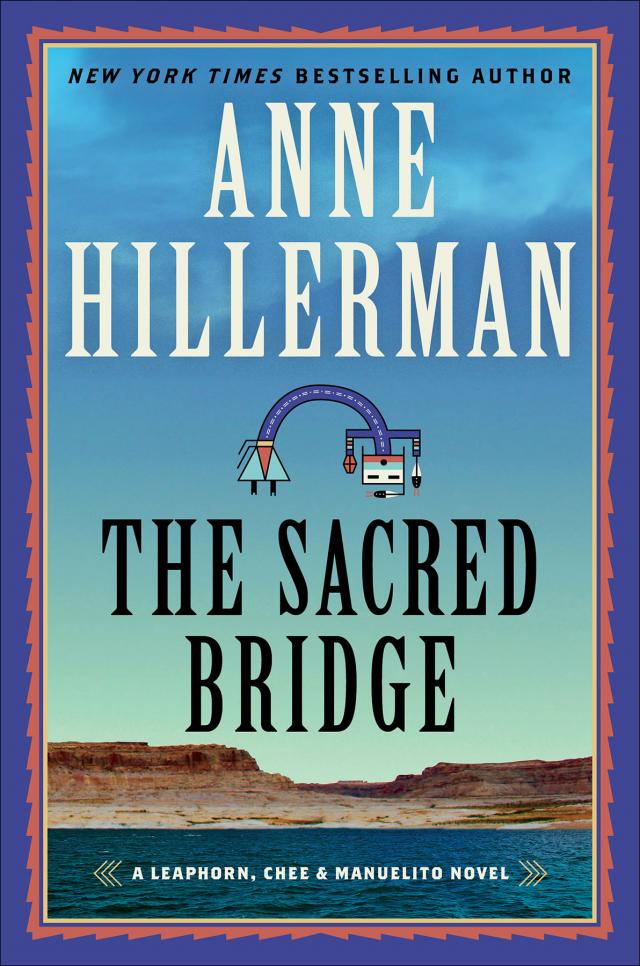
The sacred bridge, p.1
The Sacred Bridge, page 1


Dedication
To the brave men and women who devote their lives to law enforcement on the Navajo Nation
Contents
Cover
Title Page
Dedication
1
2
3
4
5
6
7
8
9
10
11
12
13
14
15
16
17
18
19
20
21
22
23
24
Acknowledgments
Glossary
About the Author
Also by Anne Hillerman
Copyright
About the Publisher
1
The young Navajo man froze for a moment and dealt with his fear.
Even all these years after the accident, looking at the vast expanse of cold lake water still left him frightened. When the nightmarish idea arose that his boots might slip and that he could tumble down the pale sandstone and into the lake, he shoved the thought to the back of his brain. But his palms had started to sweat. He took a deep breath and ordered himself to get a grip, to calm down, to go in beauty.
His apprehension had begun years before, when Lake Powell was higher and he was smaller, just a boy. He had been walking along the shoreline, looking for insects. Then he tripped on a rock and lost his balance. He could still taste his panic as the icy, bottomless water enveloped him. He could still feel the iron grip of the terror that paralyzed him. Unable to keep his head above the deadly lake, he sank, breathless, too scared to struggle.
Finally his brother’s strong arms pulled him back to life, to the surface where he could gasp for breath. After an eternity they reached the dry safety of the shore.
He was only eight, but the experience changed him from the inside out. His brother wanted to teach him to swim, but he had none of it. He knew Lake Powell was a lurking, evil monster, ready to suck him into its frigid depths. He respected its power, and now, after decades, he could sometimes see its beauty. But only from afar.
When the ancient ones he admired, the ones who had left their marks on the rocks here, saw water, they beheld rivers, the area’s flowing lifeblood. Not this giant, human-made pool trapped by a dam.
The young man forced his gaze from the water’s dangerous, seductive shimmer to the sky. He took a long breath and made himself move with caution across the unforgiving sandstone, heading back toward his campsite and then to the boat dock.
But a sound behind him stirred his curiosity and he turned, careful not to lose his balance on the steep slope.
Time compressed. First, a whooshing noise, then a heavy thunk against the back of his head. He fell forward with the sound. The searing pain lasted only a moment. After that, his damaged skull couldn’t protect his brain. If he had been conscious, he would have noticed the warmth of the rock cliff, a gift from the October sun, against the skin of his torso. But he had transitioned to the space beyond human senses. He didn’t fear his body’s growing momentum as the energy of the fall and gravity’s pull drew him toward the water. He didn’t feel the abrasive stone bloodying the skin of his arms, cheeks, and forehead. When his physical self finally slid into the deep icy water of his nightmares, he didn’t even flinch.
Death had come quickly. And now the place that had long terrified him began to make its amends. The lake gently rocked him as it washed away the blood.
2
Jim Chee looked out at the broad expanse of water known as Lake Powell.
The huge dam that created this immense desert lake had destroyed the sacred junction where two vital rivers merged. The San Juan River, the Male Water, forms one boundary of the Navajo Nation, whose people Chee served as a police officer. The water from the San Juan flowed into the Female Water of the Colorado River, whose spirit is called Life Without End, when they met in Glen Canyon. The old stories spoke of the two Navajo deities embodied in the rivers. When they joined, they created the Water Children of the Cloud and Rain People.
Some said that the dam’s dishonoring of the confluence led to the long-standing drought that had reduced the volume of the lake itself to less than half.
Chee stretched his tired legs along the sand and readjusted his back against the cliffside. A few more moments of rest, and then he’d hike on toward Rainbow Bridge. This combination of vacation and personal retreat had left him frustrated on several levels, but standing in the presence of that sacred site should provide a cure. Then the three-hour drive to Shiprock, reuniting with his smart and lovely wife, and finding time to further contemplate the future and shake off his disappointment at yet again failing his mentor, the retired Legendary Lieutenant, Joe Leaphorn.
Perhaps, Chee thought, the imprisoned water from the two sacred rivers had washed away the images of the Holy People that had left Leaphorn in awe decades before. Perhaps the water had transformed the sand paintings Leaphorn recalled so vividly into rainbows of tiny specks of colors and washed the sand away. Perhaps the sand rested on the bottom of the lake or had washed onto a beach where coots and grebes strolled and boaters pulled ashore.
Or perhaps the rising water had stopped before it reached the cave that sheltered those precious things. Perhaps. Perhaps.
This morning, as he sang his morning prayers in this soulful place, he realized that he knew of nowhere else to search for the cave that still burned in his mentor’s memory. Using the Lieutenant’s old map and his own acute sense of the geography of the Colorado Plateau, he had discovered a few caves that seemed appropriate, but none sheltered a trove of sand paintings.
He looked forward to Rainbow Bridge, a holy place near the lakeshore. He would be there in a few hours.
And then he would go home. He missed Bernie and their cozy little place along the San Juan River. He missed the men and women he worked with at the police station and beyond. He missed those assignments where his presence and something he said or did made life better, or at least more tolerable, for the person who had called for the police. He missed being of service.
But he didn’t miss the reports. He didn’t miss his role as backup in charge at the substation when Captain Largo was away. And, especially and with all his heart, he didn’t miss having to be Bernie’s boss when the captain left.
Chee took another sip of water and listened to the distant, muffled roar of a powerboat. Then he unzipped the backpack that sat in the sand and spread the map Leaphorn had given him on his lap. He studied it again. According to what he saw and the Lieutenant’s story, the cave should have been inside the cliff that warmed his back. But he had looked there, closely, and only found solid rock. The expansive, rugged landscape between Lake Powell and Navajo Mountain could have confused the map maker. Or, Chee thought, perhaps he had misread the map and made a mistake.
He heard the low vibration of the boat motor again.
Later, he realized that if he had positioned himself with eyes toward the lake instead of away from it, and if he had pulled out his binoculars at the sound of the boat, he might have seen something important. He might have seen a murderer fleeing the scene of the crime.
3
Lake Powell, a desert lake born in controversy, is an infant finding its place in the ancient geological environment of the Colorado Plateau. Its creation in 1963 as America’s second-largest human-made lake (only Lake Mead holds more water) captured the Colorado and San Juan Rivers, two of the Southwest’s major waterways. Glen Canyon Dam, constructed to provide hydroelectric power and water storage, imprisoned the water between beautiful sandstone walls. The lake had taken seventeen years to reach its high-water mark. Chee knew water levels had been declining due to both use and drought in the southwestern United States. By the summer of 2020, Lake Powell was a hundred feet lower than full pool, and at less than 50 percent capacity. And the drought continued.
Trees, shrubs, and native grass often surround natural lakes throughout the Colorado Plateau, but the rock shores of Lake Powell combine with scorching summer heat and scouring winds to prevent the verdancy that presents itself in a more hospitable environment.
Having paused in his hike to the lake’s most famous site, Rainbow Bridge, Chee considered the untouched lunch in his pack. He’d eat in a few minutes, but first, a rare nap under the clear blue October sky. Doug Walker, his wife’s clan brother and an area tour guide, had shown Chee where the trail to the sacred site began. After reminding him that it would be a lot easier to reach the bridge by water, Doug had promised that a boat would pick Chee up at the closest dock.
Chee closed his eyes and replayed Doug’s instructions. “The bridge is nine miles from the trailhead. You’ll be coming into it here.” Doug had pressed the spot with his index finger. “Our boat leaves the big marina every day around one p.m. with the last group of sightseers and arrives around three. If you miss it, either I or one of the staff will come and get you that evening.”
“No need for that,” Chee said. “I can catch up with the tour boat the next day.” Another night beneath the diamond stars and a chance to enjoy the power of Rainbow Bridge in evening’s quiet sounded appealing.
Doug nodded. “I’ll tell Curtis or Sunfish to watch for a big, tired-looking Navajo guy. If you’re there before we leave, you’ll get a seat. We’re not as busy now that kids are back in school. That’s good, because Curtis and I are cooking up something new.”
“What’s that?”
“Ah, it’s too early to talk about it.” Doug shrugged off Chee’s curiosity with his own question. “Can you guess which story of Rainbow Bridge we share with tourists?”
“Well, I prefer the tale of how one of the Hero Twins was hunting and got trapped by a flash flood. His father, Jo’hanaa’éí, the Sun and Changing Woman’s husband, sent a rainbow to save the young man from drowning. Afterward it turned to stone as a symbol of the strength of a father’s love. I also like the one about the measuring worm that transformed itself into a solid rock bridge to help the twins escape from rising water. That story has value, too. It shows how little things can make a huge difference.”
For the Diné, the graceful sandstone bridge represented more than interesting geology. Here, the supernatural and humanity had interacted, and that made Tsé’naa Na’ní’áhí a sacred place. Other tribes of the area also held the natural bridge in reverence as a blessed marvel and had their own stories of its origins and importance.
Doug had rubbed his chin. “Nope. The story we share concerns the controversy about the lake’s creation. About how the ones who built the lake disrespected the bridge and how the People stood up for it. Navajos, Hopi, Zuni, Paiutes, even some Utes. The enviros joined in, too.”
Chee recalled the struggle to preserve the bridge as a pilgrimage site instead of a tourist attraction to minimize the inadvertent and inevitable desecration that might be caused by uninformed visitors who would walk beneath the bridge—an action of disrespect—or talk too loudly or laugh too much. “Were you involved in trying to protect it?”
“Not me, bro. I wasn’t born. That was in the 1970s.” Doug laughed. “My baby brother, Curtis, he did a lot of research about the protests and the controversy. He started working with Dr. Peter Hendrix, the archaeologist from the University of Utah who was involved with all that. You heard of him?”
“No.”
“Dr. Pete is famous in these parts,” Doug said. “He did a lot of the archaeology that went down before Lake Powell started to fill. Curtis met him when he spoke at our school. My brother really got into that archaeology stuff. Every year on the anniversary of the dam’s completion, Dr. Pete encouraged us to write letters to the newspapers about the old ones who lived here. One year Curtis wrote about why Rainbow Bridge matters and included a sketch he made. We all were so proud of him when we saw that in the newspaper.
“The National Park Service, the state of Arizona, even the conservation groups, tried to help protect Rainbow Bridge from tourists, but the fact is that Lake Powell is government property, open to all comers. Then Mother Nature stepped right in. Now that lack of rain, miserable snowpack, and evaporation have lowered the water level, everyone has to walk farther. Most of them just stay in the boats.” Doug chuckled. “When we do our tours, we tell the traditional stories you mentioned and let the customers know that we’ve heard about people who died unexpectedly not long after they walked under the arch.”
“I thought that was only us Navajos who didn’t know the right prayers.”
Doug grinned. “We don’t share every detail. It keeps them from being disrespectful.”
Refreshed from his rest, Chee hiked toward the bridge. He startled a cluster of bighorn sheep. Two of them glanced up from their browsing and scampered higher over the russet sandstone. The third watched a moment longer before joining the herd. The human herd was more elusive; he only encountered two other hikers, a pair of Hopi women.
Eventually he came to a faded sign that read “Rainbow Bridge National Monument,” and a wooden fence that created a hikers’ maze. He stopped and searched the arid landscape for the first sight of the towering stone bridge, beautiful Tsé’naa Na’ní’áhí.
And then he saw it.
He breathed in its majesty as he approached, following the trail to the point where he could stand in the narrow band of shade the bridge created. He admired the height of the graceful arch—roughly as tall as the Statue of Liberty—and its strong span across the river. Some said that it represented the union of male and female as well as the cooperation of the Hero Twins who made the world safe for humanity by destroying most of the monsters who threatened to eliminate us Five Fingered beings. The reality of its presence calmed his disappointment at his failure to find the cave. He paused in gratitude, sang his prayer, and blessed the spot and the day with sacred cornmeal.
Based on the angle of the sun, he had plenty of time before the boat arrived, bringing its tour group. With the arch at his back, he walked along the lakeshore, watching the deep-blue water lap against the floating dock. What a gift, he thought, to have this powerful place to himself.
Wanting a panoramic view of the lake, he studied the sandstone for a trail that could provide such a vista. He found one that seemed promising and began to climb. The hike grew steeper, and when he paused to catch his breath, he noticed a packrat nest at the foot of the cliff with something shiny on top. Curious, he left the trail to examine the anomaly. When he pulled it from the sticks, weeds, and debris, he realized the object was a miniature thermometer. It resembled something a hiker might add to the puller on a jacket zipper. The attachment had broken, but the device still worked—if, in fact, the day was eighty-five degrees warm. He smiled, thinking of a packrat checking his thermometer. As he flipped it over in his palm, he saw a logo, a sketch of a houseboat with the words “Laguna Blue” on its side. He slipped the device into his pants pocket to dispose of later.
He climbed until he reached the mesa top and stopped to savor the view. The lake stretched below him, vast and as blue as the October sky, with a broad band of desert-brown rock separating the two. He searched the water for the tourist boat and didn’t see it—just late-season houseboats bobbing gently in the distance. He pulled out his phone to take a picture and, as he framed the shot, something bright green caught his eye. A tent. Someone had carefully positioned it to catch afternoon shade from a wind-carved overhang. Except for the thermometer, he hadn’t seen signs of human presence. Not even a boot print. He wondered who had camped here and where they were now.
He told himself he was on vacation, and the tent was none of his business. But it was on his way to his next goal—soaking his toes in the cool water. So instead of heeding his own advice, he approached it. He saw where a fire had been, but none of the cooking utensils, drying laundry, or other signs that indicated an occupied campsite.
“Hello. Anyone home?” Chee waited, then called again. “Anybody in there?” He heard no response.
He strolled to the tent. It looked expensive and well loved, lightweight and designed for backpacking. Someone had zipped the entrance flap closed. It had been untouched long enough to attract a spiderweb between a supporting pole and the emerald fabric nearest the pole. The relatively flat surface at the top had accumulated a fine layer of sand, and more sand had piled into a small undisturbed dune at the tent’s entrance. Odd, he thought; the day had been calm and windless. The tent had been here awhile.
“Hey, I’m a cop. Everything OK here?”
With nothing stirring inside the tent, and no one approaching, Chee found the zipper, scared the spider away, and opened the flap. With some dread, he squatted to look inside. As he’d expected, no one was there, but what he saw took him by surprise. No decaying corpse, but half of a large broken pot decorated with the classic black-and-white geometric shapes of the early Pueblo people lay on the waterproof tent floor. Next to it was a fiber object he identified as an ancient yucca sandal. There were three large, dark stones, which looked as if the hands of the ancient ones had shaped them into tools for grinding grain. A small group of potsherds sat next to them, as though someone had arranged everything for a photograph.
He again took out his cell phone—a device that had proven useless except as a camera in this cell-tower-scarce landscape—and snapped some photos of the display. If this were a case of grave robbing—stealing from the dead for sale to collectors—the person responsible would face serious consequences.
Someone also had left a backpack, a water filter, a rolled-up sleeping bag, and a pad, all stashed across from the entrance. He hesitated. If whoever camped here returned to find a stranger rooting around in the tent, Chee risked an angry confrontation before he could explain that he was a policeman with legitimate concern for the owner’s safety. But the person who set up this campsite could be hurt or lost and he wasn’t a man to ignore the situation.