Radix the radix tetrad b.., p.1
Radix (The Radix Tetrad Book 1), page 1
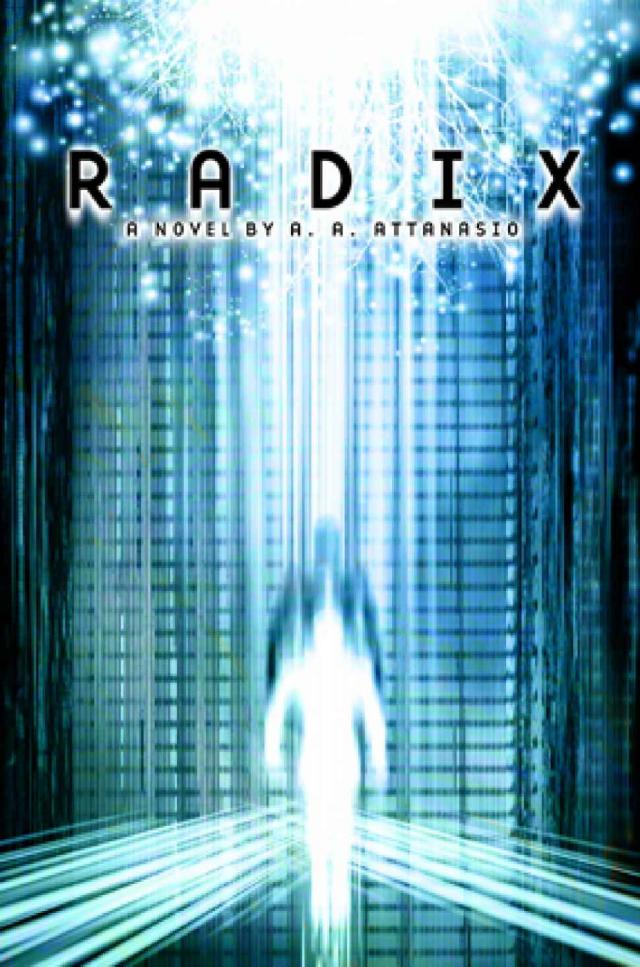


Radix
A. A. Attanasio
Radix
Volume One | The Radix Tetrad
published by Firelords Press
Ignite your imagination!
Copyright © 2013 A. A. Attanasio
http://aaattanasio.com/
First published 1981 William Morrow
Library of Congress Classification: PS3551.T74 R3
Cover Art: John Bergin
http://web.mac.com/grinderx/Site/home.html
Interior Illustrations: James O’Barr
http://jamesobarr.typepad.com/my_weblog/
For
Lightworkers
across time and space.
Contents
Distorts
Firstness
Pictures of the Real Universe
Teeth Dreams
Voors
The Mysteries
The Emptying
The Blood's Horizon
Godmind
Destiny as Density
Trance Port
The Untelling
Epilog
Appendix
Worldline
Profiles
Argot
Things can be –
and their Being is grounded
in Nothing's ability to noth.
— Kenneth Burke,
Language as Symbolic Action
DISTORTS
No man knows himself.
— Yi Jing
Firstness
Blinded by the headlights, Sumner Kagan lunged off the road and slid down the dirt embankment into the dark. Above and behind him braking tires squealed furiously. Savage voices yowled as the Nothungs, in leather streetgear, rolled out of their Death Crib and chased after him. Five viper-thin men with blood-bruised eyes and teeth filed to points charged down the slope yelling, "Run, Wad—run!"
At the bottom of the incline Sumner veered into the marsh. He looked like a spooked cow in the dark, waddling heftily side to side. The Death Crib's headlights shimmering off his smudged and tattered shirt, he pushed into the tall grass, arms flailing wildly. His night vision had returned, and he could see clearly the squat silhouette of the alkaloid factory on the horizon. He knew there was a packed dirt path somewhere around here.
Not far behind, the Nothungs whistled chains through the air, howling and cracking stones together. If he merely stumbled, he would be torn to pieces—the police could search the marshes for weeks and still they wouldn't find all of him. He thrashed through a brake of cattails, and then his feet hit hard earth. It was the path, a straight run to the alkaloid factory. In the west, the Goat Nebula was rising. He screwed his mind into that brilliant green spark and kept his thick legs pumping.
When he reached the chain-link fence of the factory, the Nothungs were close enough to pelt his broad, stoop-shouldered back with scattered handfuls of gravel. There was barely time to locate the hole that he had sheared through the fence earlier that day. He found it beneath the massive and mud-streaked billboard: NO GO! TRESPASSERS SHOT!
Bellycrawling through, he strained to haul his corpulent body upright and jog onward. He banged up a long metal ramp toward a broad staircase that ascended into the dark galleries of the factory.
It was bad planning, he told himself, to have to climb stairs after such a long run. It might all end here. Rau! Legs numb with fatigue, heart slamming in his throat, he fixed his eyes on the dark shadows at the head of the stairs and ignored the pain that stabbed him more sharply with each step.
Just as he made it to the top, one of the Nothungs clutched at his pants and ripped off his back pocket. Desperately, spastically, he sprawled forward and kicked free. Struggling with his own pendulous weight, he pulled himself to his feet as the Nothungs came bellowing over the top.
Exhaustion staggered him, but he fought against it. The big vat was up ahead. He could see it below through the wire mesh of the ramp.
The Nothungs came up strong directly behind him, ricocheting chains off the pipes on either side. They thought they had him trapped. Alone, in an abandoned factory. That appealed to their imaginations. Sumner had known it would.
The silver scars on the metal post, where the DANGER sign had once been, blurred past him, and Sumner took its cue and leaped. The knotted rope was there all right, and its stiff threads stung his pulpy hands as he swung heavily to the other side. Two sharp screams rang out behind him, two splashes.
Swiftly, he looped the rope around the railing and, plodding off into the darkness, found the broad pipe that would carry him back to the other side. He staggered along it, adjacent to the ramp where three silent Nothungs meekly peered down into the darkness that had swallowed their companions. An emergency water-hose waited where he had left it. He had tested it that morning.
One of the Nothungs yelled across the darkness: "We'll find you, fat boy! We'll rip you!"
"Aw, blow it out, screwfaces," Sumner answered, just loud enough to be heard. He had already turned the waterpower on, and as three faces dark with rage spun around, he opened the valve. The blast clipped their legs out from under and logrolled the Nothungs off the ramp, their wails lost in the hiss and bang of water hitting acid.
∞
Sumner listened deeply to the hissing water as he crouched with fatigue over the limp hose. Breath tight in his throat, leg muscles spasming from the hard run, he paused only briefly before taking a canister of red spray paint from its hiding place beside the water-hose. With an unsteady arm he mist-scrawled on one of the broad overhead pipes: SUGARAT.
∞
Sumner didn't stop to rest until he got to his car in a lot behind the factory: a standard bottle-green electric car, squarebacked, with three small hard rubber tires and two scoop seats. He loved it more than anything else. It was his home, more of a place of fealty and comfort than the rug-walled residence he shared with his mother.
He slumped over and laid his head and arms on the cool metal roof. When he caught his breath, he opened the door and dropped into the driver's seat, head lolling back against the headrest. One hand fingered the wooden steering wheel, and the other dangled over a carton of stale crumbcake. He stuffed a morsel in his mouth, and though it was dry and powdery, a fossil of its original flavor spread over his tongue. He closed his eyes to savor it. He hadn't eaten in two days. He had had to settle this thing with the Nothungs, and he couldn't enjoy eating when he was thinking about killing. But now that was over. It was time for the Tour. His stomach grumbled in anticipation.
Stuffing another block of cake in his mouth, he slid the starter chip into the ignition slot. He felt warmth spread over him as he opened the clutch, set the car in gear, and wheeled out through the elephant grass.
Sumner and his car had a lot in common. They were both bulky, squarebacked, and sloppy. Dunes of crumbs drifted out of the corners and over stains of beer, gravy, and pastry fillings. Shreds of wrapping paper, crushed cookie cartons, a bedraggled sock, and numerous bottle caps had wedged between the seats and under the dash. And there on a battered card taped to the windshield, beneath the particolored triangular Eye of Lami—which Jeanlu the witch-voor had given him as protection from his enemies—three words defined him: BORN TO DREAD. Their ambiguity pleased him. Besides eating, the thing he did most consistently and with the most fervor was dread.
Anxiety sparked through him constantly. And though he hated its hot taste in the back of his throat, he accepted it as one of the necessary indignities of life. So he ate, as if his dread were something that could be smothered somewhere deep in his gut, broken down, and digested.
But his real obsession wasn't food or anxiety. He wanted to be dreaded. He wanted to be the legendary Dark One—magic shining through his ugliness, indifferent to loneliness, deep and calm with violence. He wanted everyone to know he was dangerous.
The problem was that no one ever witnessed his daring deceptions. He was the Sugarat. And no one knew.
In the past six years, the Sugarat had achieved a notoriety that hinged on myth. At first he had singled out streetgangs who had humiliated or abused him. He had trapped and destroyed them for his own gratification, never considering that there would be repercussions. His first few kills had created such a power imbalance among the many gangs of McClure that street warfare raged as never before. Rival gangs warred to fill the vacancies the Sugarat had opened. Firebombs exploded in homes of gang leaders. Assassinations bloodied commuter trains. Hand to hand combat in markets and shops became commonplace in the days that followed each of the Sugarat's vendettas.
Sumner thrived on this power. He began to kill more often, for insults and slights he wouldn't have noticed before. He had become important. He had found a way of shaking the world. Of course, there was always the very real likelihood that one of his ploys would backfire; yet, the dread of a gang mauling him in no way matched the loathing he felt for himself when he was alone and bored. Only dread and a little luck had kept him alive this long.
Now the police wanted Sugarat, and that was something else. For six years they had known he was behind the spasms of violence wrenching the city. They wanted him at any price, but there was nobody, not one weasel to betray him, not one witness or skinny-shanked clue to point him out. Nobody knew the Sugarat.
That was why Sumner needed the Tour—to feel what he had done in the past, to know who he was now.
He drove first along a rutted dirt road that smoothed into a causeway and curved out of the industrial district. In a few minutes, h
"Zh-zh," he hissed when the station picked up. The officer at the other end groaned, recognizing the ritual greeting of the Sugarat. Sumner smiled and in a mumbled whisper told the police where they could find the Nothung corpses. Then he hung up and, tucking his torn shirt in as he went along, lumbered over to the counter and ordered six sandwiches to go. He liked his sandwiches wide open and sloppy: horseneck clams with miso and seaweed; chunks of veal blanketed in a mushroom sauce of puffballs and chicken-of-the-woods. At The Bent Knife, however, he settled for egg gumbo on toast and barley rolls stuffed with hot pressed tongue.
He drove back into the ancient, burned-out factory district. He didn't touch his food but let its steamy odors graze his nostrils with the seductive promise of heartburn.
The Tour began at the site of the first kill of his life. It was a fire-gutted warehouse, just a sunken-in crater with three scorched aluminum walls tottering around it. He parked his car where he could clearly see the seared white ash of the interior and, on one of the ribbed aluminum walls, streaked with mud and smoke, the huge scrawled letters SUGARAT.
He broke out one of the egg sandwiches, sniffed it appreciatively, then devoured it as he reminisced. He had killed seven members of the Black Touch here. The hardest part had been getting the gasoline. Fuel was expensive, and he had nearly starved himself to afford enough of it. As for the liquid detergent, he had simply waited for a shipment to come in to the local mart and then, in the delivery boy outfit from his current job, rolled off a barrel in a trundler to the kill site. Mixed together, the gasoline and the thick detergent made an extremely viscous incendiary. He had used a bucket and pulley to fill three drums with it in the rafters of the warehouse, a chore which had taken him hours. The strategy had been the same. When the razor-fisted headbreakers of the Black Touch chased him into the building, he had doused them with the fire-gum and touched them off with a torch flare. The burn had been beautiful, the screaming brief. It was his best kill. A perfect dupe. Everything he had done in the six years since was derivative.
Sumner cruised kill-sites, enjoying his food and replaying strategies. Stacked vertically on the I-beam of a broken trestle, the letters SUGARAT marked a black tumulus of rail gravel. This was where Sumner had lured a whole gang of Bigbloods beneath the drop-zone of a gravel loader. When the chute opened they had been sighting him with their makeshift nail-slings. They never got off a shot.
At another killing area, with the dank susurrus of a bog twirling about him, he sat on the hood of his car nibbling a barley roll. He gazed into the darkness at the shape of dead trees where the Slash headbreakers had pursued him over a swampbridge. The bridge had been tricked to collapse, of course. But the real shocker for the headbreakers came after they sloshed into the bog—when Sumner ignited the fire-gum coating the enclosing mud.
With his last sandwich eaten, Sumner was parked again outside the alkaloid factory. He figured the police had come and gone, because the Death Crib had been taken away.
He only vaguely remembered why he had killed the Slash, the Black Touch, and the Bigbloods. Remembering was hard. He didn't think about his life much. He wasn't one to brood, though his problems loomed larger each day. He had been out of work for a year and, at seventeen, was already the father of a five-year-old boy who terrified him. Even so, he rarely mulled over his life. Muscular intuition motivated him, an urging in the meat of his body to eat, to kill, to find sex. It was his dread.
For Sumner, finding sex proved a lot more difficult than setting up a kill. He was big and ugly: six foot five, with rolls of fat bagging under his eyes, coiling around his neck, swaying like tits under his shirt. His face was glazed with seepings of subcutaneous grease and crusty with eruptions that never went away but only migrated across his features. He had tried growing a beard, but it came in mangy and made him look diseased. Seeing himself disgusted him; so, he had ripped out the rearview mirror in his car and kept apart, even from himself.
On the way back into McClure, Sumner picked up some pastries and cruised through the residential streets, eyeing the houses of the many women he desired.
McClure was an old city, maybe four hundred years old, and like most of the towns that had cropped up this deep in the interior, it was made of stone. At least the older buildings were. This was a matter of necessity, since the weather was dangerously unpredictable. Fierce cyclones—raga storms—with winds of four hundred kilometers an hour swooped across the country with little warning. Whole cities sometimes vanished, populations erased, coastlines reshaped. Nonetheless, in the more affluent sections, wooden houses perched on hills, status symbols in the truest sense, meant to be abandoned when the raga storms came.
As part of the nexus of McClure's society, the wealthy had been able to reserve cubicles in the Berth, a massive citadel in the center of town. Even if completely buried by a raga storm, the Berth contained enough oxygen, food, and water to sustain thousands of people until they could dig themselves out.
Sumner packed a honeytwist into his mouth and farted when he passed the orange nite-glo sign with the Massebôth symbol on it. The two shining pillars marked the inner city limits and declared that the area was under Massebôth protection.
The symbol exhibited an ivory column beside one of black obsidian. The ivory, as Sumner remembered from his grim two years of mandatory civil education, represented cultural preservation and advancement. Basic technologies of petroleum refinement, vulcanized rubber, antibiotics, transistor circuitry, and too much else that had been taken for granted for years disappeared after the apocalypse that ended the kro-culture. Those that had survived the holocaust and the dark centuries that followed were many generations past any memory of civilization. Only a handful had preserved snatches of the old applied sciences and culture. In time, they got together and assembled a civilized community. The Protectorate emerged only centuries later. The white pillar signified this heritage.
The obsidian pillar stood for the muscle of the Protectorate. Though the Massebôth had confined their society to the eastern seacoast, with only a few settlements like McClure in the interior, they had the military strength to dominate a much larger empire. What confined them was not the threat of the tribes to the north and west but something wrong with the human race. Distorts—genetically malformed people—appeared more commonly than not these days, and the Massebôth, who preferred stability, had their hands full keeping their population strong.
Also, most of the planet remained unmapped. The Protectorate just didn't possess the resources to cope with the vastness and strangeness of their own continent, let alone the rest of the world. A lot was left unexplained—like devas. Military reports, two famous film clips, and rumors described the awesome power of devas. No one knew what they were, or even if they were intelligent. They had apparently saved endangered explorer-craft, but they had also smashed mapping-balloons that had journeyed too far north. Vast funnels of light descending from the stratosphere mesmerized witnesses—always deep in the unmapped north.
Sumner took the word of his teachers that there had been a time before devas and distorts and raga storms. He didn't think much about it, but he liked to feel that he was informed. That's why he hated going through center-city McClure. There on the massive time-stained walls of the Berth, which housed the university and all the administrative buildings, he confronted scrawls, graffiti, cerebral vomit. Instead of the streetnames or gang slogans brightly streaked throughout his neighborhood, nonsense defaced the Berth walls—
YOU ARE THE PERPETUAL STRANGLE
BELIEVE IN NEVER NOTHING ALWAYS
AMNESTY FOR THE DEAD!
These absurdities infuriated him. But there was no way for Sumner to get to where he was going without passing the Berth. Tonight, as the walls loomed closer, their smoky searchlights swinging overhead, he spotted a new scrawl, much larger than the rest—